
D&D Story Generator
Turn a blank night into a one-shot you can finish tonight—hook, NPCs, encounters, and XP.
Party Configuration
Separate multiple keywords with commas
First-time visitors can generate 1 result for free, no sign-in required. Credits are only needed after the free trial.
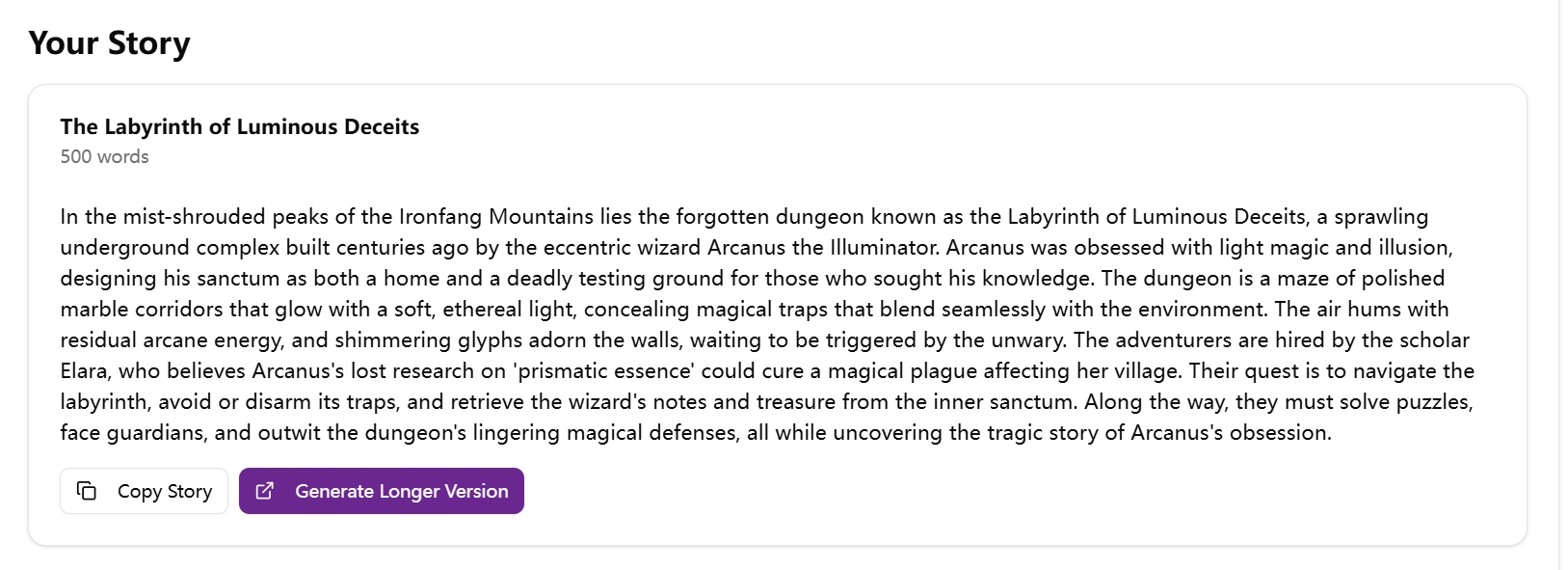
This sample shows the output style and structure this tool can generate.
Move this result into the next focused tool instead of starting over.
How the D&D Story Generator Works
Turn a blank night into a one-shot with a hook, NPCs, and 2–4 encounters.
Add your adventure idea
Type a quest like finding a legendary artifact, or leave it blank for a random one-shot.
Set keywords
Add elements like dungeon, dragon, or quest to steer the encounters and flavor.
Generate tonight's session
Click Generate D&D Adventure to get a one-shot you can finish in a single session.
Why Choose This Generator
D&D Story Generator
Build a playable adventure—a hook, encounters, NPCs, and a payoff—ready for your table.
Three-Pillar Balance
Adventures weave combat, roleplay, and exploration so no single pillar dominates a session.
Memorable NPCs and Hooks
Get characters with a want, a secret, and a quirk, plus hooks that pull players in fast.
Finish in One Session
Get a hook, 2–4 encounters, NPCs, and XP sized to wrap when the clock runs out tonight.
Who It Is For
Dungeon Masters
Skip hours of prep and generate a session skeleton—hook, encounters, and a payoff you can finish tonight.
New Players and DMs
Learn adventure structure by running a ready-made one-shot, then tweak it as you get comfortable behind the screen.
One-Shot Tables
Generate a self-contained quest with a clear win condition, then tweak names to fit your world.
Writing D&D Adventures Your Party Will Remember
Players forget dungeon layouts; they remember the moment the goblin surrendered, the door that argued back, the choice that split the party's loyalties. A memorable session runs on decisions with consequences, not just monsters with hit points. A D&D story generator helps by sketching the skeleton—the goal, the twist, the stakes—so you can spend prep time on the details. Searches for a D&D adventure generator and a D&D story generator point at the same need: a session-sized outline with a hook, two or three encounters, and a payoff you can run tonight.
- Give every encounter a reason to exist beyond combat
- Let the players' choices change what happens next
- Sketch the goal, twist, and stakes before filling in details
Balancing Combat, Roleplay, and Exploration
The classic three pillars need a rhythm, not a schedule. Too many back-to-back fights exhaust players; too much talk loses the dice-rollers. Weave them so each feeds the next: a tense negotiation that tips into combat, a chase that becomes exploration. Know your table, and let that guide the mix.
- Weave combat, roleplay, and exploration so each feeds the next
- Let a negotiation tip into combat or a chase into exploration
- Tune the mix to your table's taste for tactics or theater
Creating Memorable NPCs in Minutes
A great NPC needs three things: a want, a secret, and a quirk the players can latch onto. The innkeeper who wants the party gone—but hides a letter from their brother. The guard who won't stop rhyming. Players remember one vivid detail better than a full page of backstory.
- Give each NPC a want, a secret, and a quirk
- Make the secret collide with the party's goal
- Lean on one vivid detail over a full backstory
Hooks That Pull Players Into the Plot
A hook is a question the players can't ignore: why is the town empty at noon? Who sent the letter with no signature? The best hooks offer a mystery, a reward, and a deadline all at once, then hand the players a reason to care beyond gold. Tie the hook to a backstory or a favorite NPC and it becomes personal.
- Pose a question the players simply can't ignore
- Bundle a mystery, a reward, and a deadline into the hook
- Tie the hook to a backstory or favorite NPC
Improving When Players Go Off-Script
Players will burn the map and befriend the villain; that's the game, not a failure. The skill is improvising consequences that keep the story coherent. Ask what the world would do next, then let it respond believably. A D&D story generator can regenerate a twist on the fly while the table's chaos steers the story.
- Treat off-script choices as the game, not a failure
- Ask what the world would do next and respond believably
- Keep flexible scenes ready to absorb the party's chaos
The One-Shot Skeleton
A one-shot needs a tight spine: an opening hook, three encounters that escalate, and a climax with a clear win condition. Introduce the goal in the first five minutes, keep the party moving, and design the finale so it can wrap up whenever the session clock runs low. Elegance beats sprawl every time.
The Memorable Villain
Give the villain a motive the players can almost sympathize with, plus one cruel habit they can't ignore. A villain who believes they're right is scarier than one who's simply evil. Let the party meet them early, not just at the end, so the final confrontation carries personal weight and history.
The Twist Encounter
Subvert one assumption per session. The treasure chest is a mimic; the captured goblin is the informant; the wise sage is the traitor. A twist works best when the clues were there all along, so plant one odd detail earlier that only makes sense in hindsight. Surprise earns its place through fair play.
The Improvised NPC
When players interrogate a guard you never planned, invent three facts on the spot: a name, a worry, and a rumor. The worry makes them human; the rumor hands the party a thread to pull. Jot the name down—players love when a nobody returns later in the same night with a grudge or a favor.
See What It Creates
A sample of the playable adventures you can generate for your table.
Frequently Asked Questions
Explore More Story Tools
Roleplay Scenario Generator
Roleplay scenario for the table before the one-shot.
Try Roleplay Scenario GeneratorBackground Story Generator
Write NPC or PC backstory without turning this into a campaign.
Try Background Story GeneratorFantasy Story Generator
Shape epic fantasy flavor for any tabletop setting.
Try Fantasy Story GeneratorReady to Create Your Next D&D Adventure?
Turn a blank night into a one-shot you can finish tonight and get 20 free credits on signup.












































 Featured on AI Ranking










 Just Hunt