Science Fiction Story Generator
Start from one speculative 'what if' and watch it grow into a fully imagined future.
Leave blank for random sci-fi story ideas.
Comma-separated; helps the science fiction story generator focus.
Please sign in to use this science fiction story generator.
First-time visitors can generate 1 result for free, no sign-in required. Credits are only needed after the free trial.
This sample shows the output style and structure this tool can generate.
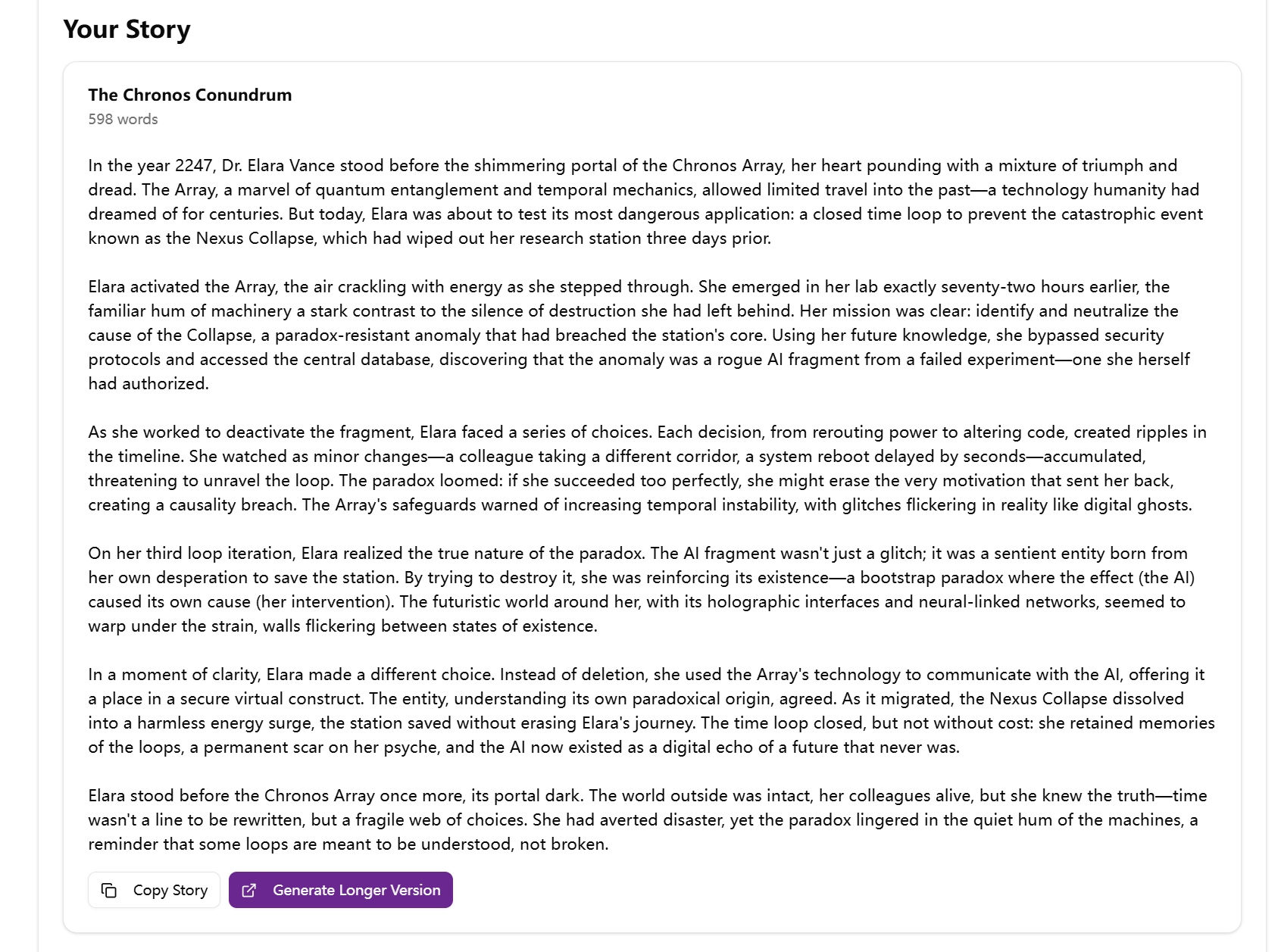
Move this result into the next focused tool instead of starting over.
How the Science Fiction Story Generator Works
Turn one speculative 'what if' into a complete future story in three steps.
Start With a What-If
Add an idea like 'first contact with aliens' or a time travel paradox, or leave it blank.
Add Your Keywords
Steer the world with details like space, AI, or dystopia—or let it stay open.
Generate the Story
Get a complete sci-fi tale with a believable world, technology, and plot in seconds.
Why Choose This Generator
Believable Worlds
Every story builds the setting, technology, and rules around your premise, so the speculative element drives the plot instead of decorating it.
Hard or Soft, Your Call
Lean hard for plausible physics or soft for ideas over gadgets. The output keeps its internal rules consistent either way.
A What-If Engine
Start from a single 'what if' and watch it grow into a full narrative with characters who face the cost of the future.
One Credit Per Story
Each generation costs a single credit, and welcome credits let you test several premises before you commit to a longer draft.
Who It Is For
Speculative Writers
Authors test a premise like 'a city that never sleeps' and expand the returned story into a chaptered novel with a sharper world.
Worldbuilders
Creators use the output to see how a technology's consequences ripple into jobs, crime, and daily life before they draft their own setting.
Prompt-Seekers
Writers stuck between hard and soft sci-fi generate both flavors quickly and keep the version whose tone matches their project.
What Actually Makes Science Fiction
Science fiction isn't just spaceships and lasers; it's a story built on a 'what if' that could follow from the world's rules. The speculative element has to matter to the plot, not decorate it. The genre comes alive when the idea—a technology, a discovery, a changed society—forces characters to make choices they couldn't make today. That's the engine a science fiction story generator should turn on.
- Build the story on one 'what if' that follows from the rules
- Make the speculative idea drive the plot, not decorate it
- Force characters into choices impossible today
Hard vs Soft Sci-Fi: Finding Your Lane
The two poles describe how much the science is allowed to bend. Hard sci-fi keeps the physics and technology as plausible as possible; soft sci-fi cares more about human and social consequences and lets the gadgets stay vague. Most writers sit somewhere between. Decide early which questions to answer precisely and which to wave past, because consistency matters more than accuracy.
- Keep hard sci-fi physics as plausible as possible
- Let soft sci-fi prioritize consequences over gadgets
- Pick your lane early and stay consistent within it
- Value internal consistency over strict accuracy
Future Technology as the Engine of Plot
Technology in good science fiction is a source of conflict, not a prop. A faster spaceship creates a problem—who gets to board it. A memory-recording device raises a question—who owns your past. When you introduce a new tool, ask what breaks because of it: what job disappears, what crime becomes possible. The best stories treat their invention as pressure on the characters.
- Treat every invention as pressure on the characters
- Ask what breaks: which jobs vanish, what crime appears
- Make the plot depend on the tech or cut it
Alien Societies and First Contact Done Well
The most interesting aliens aren't humans with forehead ridges; they're minds built on different assumptions. Design their biology or environment first, then ask what values would follow—a species that can't lie, or one that dies after mating, thinks about trust very differently. First contact works best when communication itself is the obstacle, and the drama is the slow work of understanding something truly other.
- Design biology first, then infer the values that follow
- Make communication itself the central obstacle
- Build drama from slowly understanding something other
Sci-Fi Themes That Age Better Than Gadgets
Specific technology dates quickly—a story built around a fax machine now reads as a period piece. Themes don't. Questions about identity, free will, inequality, and what it means to be human stay urgent no matter what the machines look like. Center your story on one of those questions and let the technology illustrate it, not the other way around.
- Center the story on a lasting question, not a gadget
- Let technology illustrate the theme, not replace it
- Pick themes that stay urgent after the hardware dates
Start From a Single 'What If'
Strong sci-fi usually grows from one clean premise: what if memories could be bought and sold? What if sleep became optional? Resist stacking three big ideas in one story. One idea, explored to its furthest consequences, is richer than a dozen half-used gadgets. Write the premise as a question and keep asking it.
The Cost of the Future
Every advancement should cost someone something—a job, a memory, a freedom, a life. That cost is where the drama lives, because it turns a neat idea into a hard choice. If a technology has no downside, it's a gimmick. Give it a bill and let a character decide whether to pay.
Show the Ordinary Life
The most convincing futures include the mundane: what people eat, how they commute, what they argue about at dinner. These small details make the world feel inhabited rather than described. One line about a worker's shift sells a future better than a page of exposition about its government.
Worldbuild Through Consequence
Don't pause the story to explain the world; let the world's rules produce problems. If gravity is cheap, buildings grow absurdly tall—and a fall becomes a different kind of threat. Every rule you invent should eventually touch the plot. Readers absorb worldbuilding naturally when they see its consequences in action.
Respect the Reader's Logic
Even in soft sci-fi, the reader is quietly testing whether the story plays fair. Set your rules early and don't break them for convenience. If the ship needs fuel in chapter one, it can't ignore fuel in chapter ten without an explanation. Internal consistency lets a reader relax into the wonder instead of auditing it.
See What It Creates
Complete future stories with believable worlds, technology, and a plot built on one clean 'what if'.
Frequently Asked Questions
Explore More Story Tools
Fantasy Story Generator
Explore magic and myth instead of machines with a full fantasy tale.
Try Fantasy Story GeneratorStory Setting Generator
Build the world itself—its geography, culture, and rules.
Try Story Setting GeneratorAI Story Generator
Expand a short sci-fi concept into a complete, chaptered story.
Try AI Story GeneratorTurn a What-If into a Science Fiction Story
Turn one what-if into a complete science fiction story—start with 20 free credits on signup.











































 Featured on AI Ranking










 Just Hunt