Story Prompt Generator
Turn a theme or genre into five ready-to-write prompts in seconds.
Separate multiple themes with commas
Please sign in to use this tool
First-time visitors can generate 1 result for free, no sign-in required. Credits are only needed after the free trial.
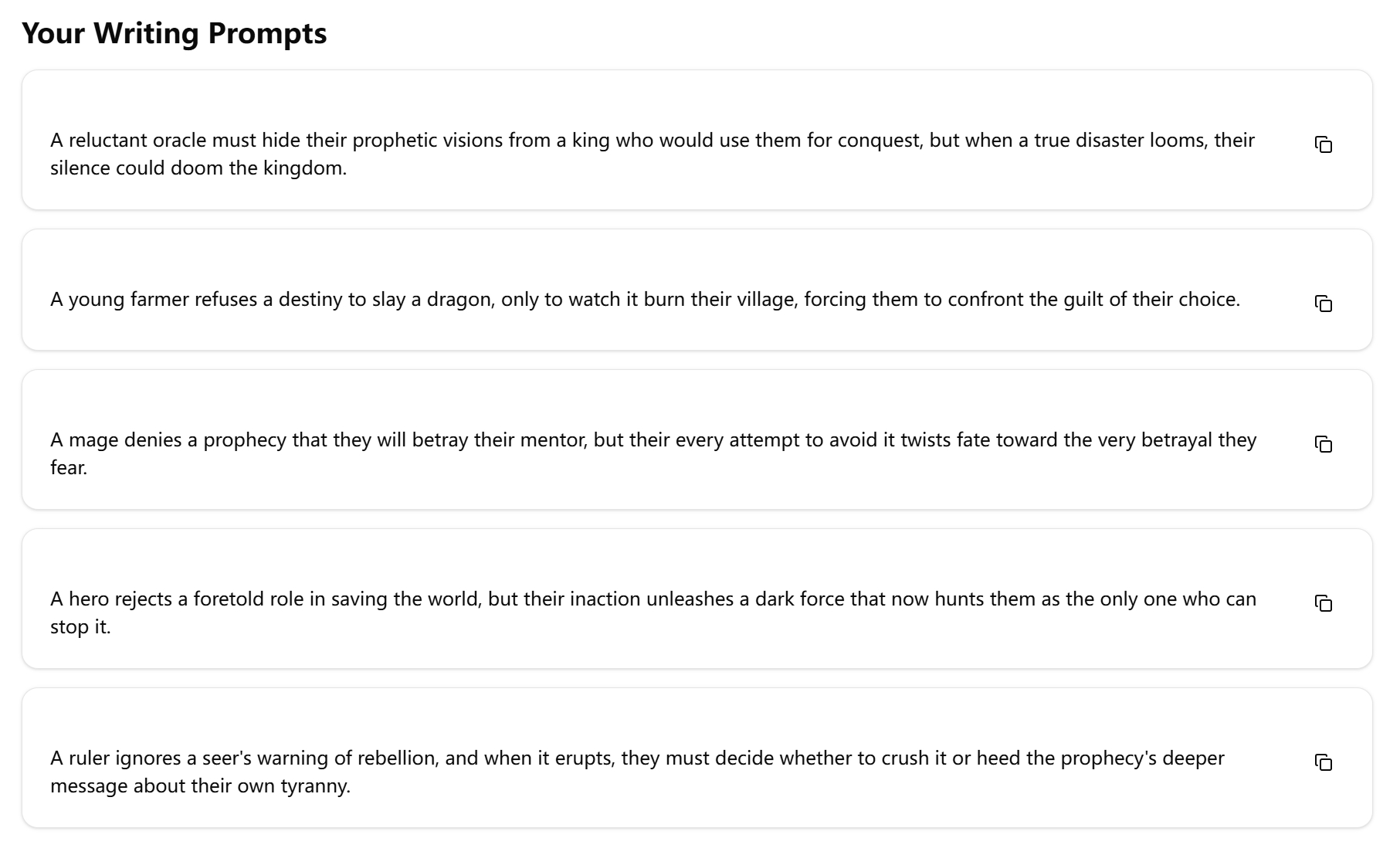
This sample shows the output style and structure this tool can generate.
Move this result into the next focused tool instead of starting over.
How the Story Prompt Generator Works
Get five ready-to-write ideas from a theme or genre in three quick steps.
Pick a genre
Choose a genre so each prompt fits the kind of story you want to write.
Add a theme
Add a theme or a few keywords to steer the ideas, or leave it blank for a surprise.
Generate five prompts
Get a batch of openings with situation, character, and tension — then start writing.
Why Choose This Generator
Five Prompts at Once
The story prompt generator turns a theme or genre into five ready-to-write ideas, so you always have a next step.
Genre-Matched Ideas
Prompts shaped to mystery, romance, horror, fantasy, and more, each with its own tension.
First-Line Openers
Draft an opening sentence when the blank cursor is the only thing standing in your way.
A Reusable Library
Save the prompts that work, combine them later, and turn a favorite into a full story.
Who It Is For
Daily writing practice
Generate a fresh batch each morning and write for ten minutes, so the habit stays easy and the blank page loses its power.
Classrooms and workshops
Hand out genre-matched prompts for warm-ups, timed writes, and group exercises that get everyone started fast.
Stuck writers
Break a block with five concrete starting points, pick the one that itches, and let the others wait in your library.
What Makes a Writing Prompt Great
A great prompt is specific enough to aim you, open enough to leave room. 'A chef discovers the locked pantry only opens after midnight' gives you a world, a mystery, and a schedule. The best prompts hand you tension, not answers. A story prompt generator pairs genre, situation, and twist, but you're still the one who runs.
- Pair a genre, a situation, and a small twist in every prompt
- Favor tension and open choices over ready-made answers
- Keep the writer in control of where the prompt leads
Prompts Built for Different Genres
Genre shapes what a prompt should hand you. A mystery needs a secret and a reason to chase it; a romance needs two people with something between them. Horror needs a rule that's about to break. Pick the genre and let the constraints do the work.
- Match the prompt to the genre's core tension
- Give mysteries a secret, romances a friction, horror a breaking rule
- Let genre constraints shape each prompt for you
The First Line: Your One Chance to Hook
The first line is a promise to keep reading. 'It rained the day the letters stopped' implies loss, mystery, and a before-and-after. You don't need the whole plot in one sentence — just enough friction to make someone turn the page. Treat it as a spark, not a final draft.
- Write just enough friction to force a page-turn
- Treat the opening as a spark you can sharpen later
- Replace a blank cursor with a concrete first sentence
Prompts for Every Skill Level
Beginners need prompts with clear direction and low stakes. Intermediate writers benefit from a structural challenge — a time limit, an unreliable narrator, a reversal. Advanced writers can take a simple prompt and twist it. Dial the complexity by choosing genre and theme.
- Start beginners with clear direction and low stakes
- Add a structural challenge for intermediate writers to try
- Let advanced writers twist a simple prompt their own way
Building a Personal Prompt Library
Prompts are reusable, so keep the ones that work. Save your favorites with a one-line note about why each landed, and over time you'll spot the themes and tones that suit your voice. When you're stuck, pull three and combine them.
- Save favorites with a one-line note on why they landed
- Review the library to spot themes and tones that suit your voice
- Combine three saved prompts when you feel stuck
Creative Writing Prompts for Daily Practice
A creative writing prompt generator works best as a daily habit rather than an emergency fix. Writers searching for a writing prompt generator usually want one thing: a starting line strong enough that the hand keeps moving before the inner editor wakes up. Pull one prompt, set fifteen minutes, and write without scrolling back. Because this story prompt generator separates prompts by genre and skill level, the same morning routine stays useful whether you are warming up for a novel chapter or teaching a classroom of reluctant writers.
- Pull one prompt per day instead of browsing ten without writing
- Set a timer first; the prompt decides the direction, not the length
- Keep every finished warm-up in one file as raw material for later
- Reuse a favorite prompt a month apart and compare the two versions
Character Prompts
Start from a person, not a plot. 'A courier who never opens packages' gives you a protagonist and a secret at once. Character prompts suit writers who build outward from voice.
Setting Prompts
Anchor a story in a place: 'a library that fines you in memories.' The setting itself becomes the conflict. Ideal for worldbuilders and atmosphere-driven fiction.
Conflict Prompts
Begin in the middle of trouble: two people want the same thing, and only one can have it. Conflict prompts jump straight past setup into the part readers love.
Dialogue Prompts
Start with a line of speech — 'You promised you wouldn't tell.' The voice and the betrayal are already in the room. Great for sharpening ear and pacing.
What-If Prompts
One small change, one big consequence: what if sleep became a currency? What-if prompts open speculative and literary doors fast.
See What It Creates
Five ready-to-write prompts with a situation, a character, and a little tension.
Frequently Asked Questions
Explore More Story Tools
Beat Writer's Block with a Story Prompt Generator
Turn a theme into five ready-to-write prompts in seconds — get 20 free credits on signup.












































 Featured on AI Ranking










 Just Hunt