
Romance Story Generator
Shape a love story around the exact trope and tone you want—from first glance to the moment it all pays off.
Separate multiple keywords with commas
Please sign in to use this tool
First-time visitors can generate 1 result for free, no sign-in required. Credits are only needed after the free trial.
This sample shows the output style and structure this tool can generate.
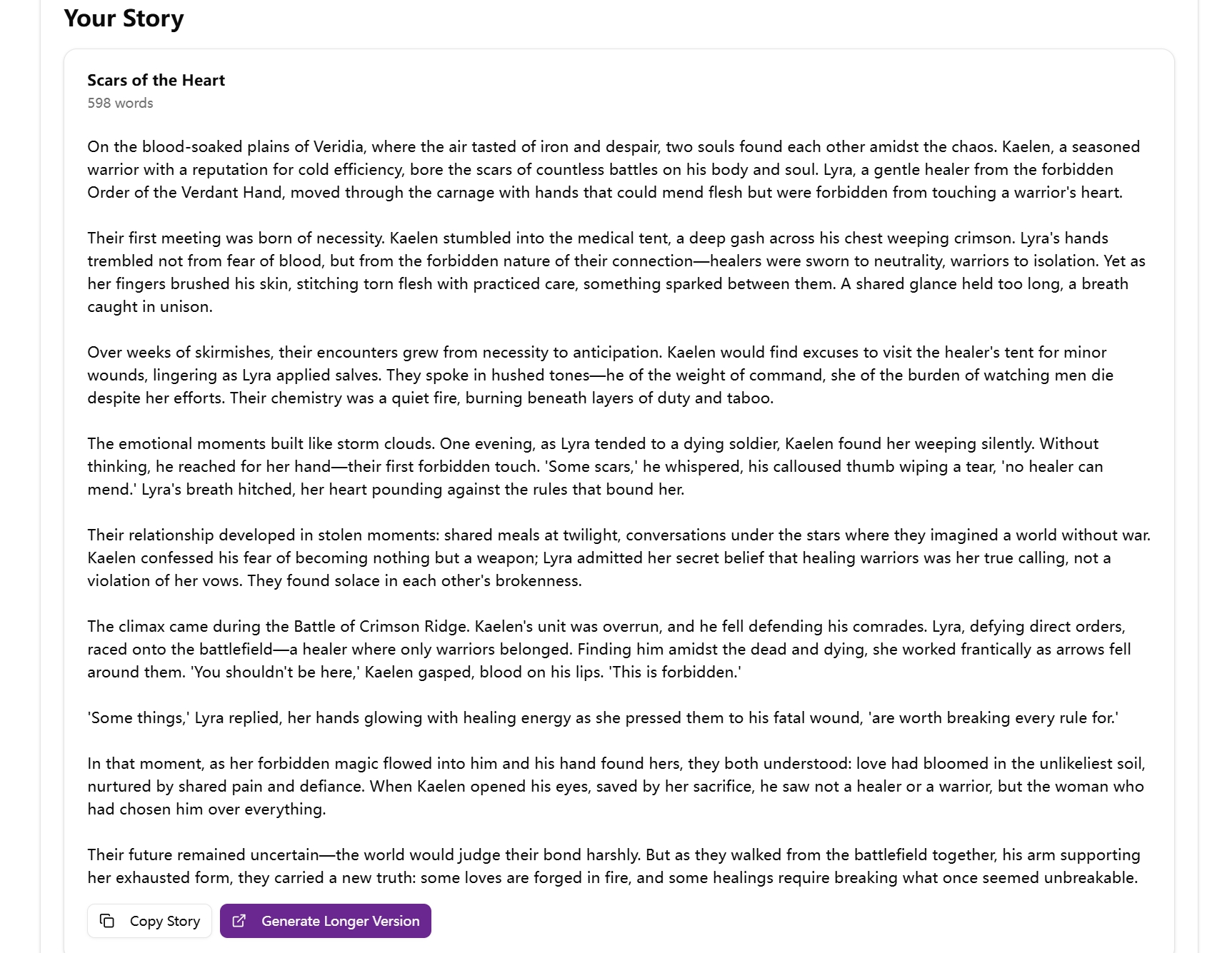
Move this result into the next focused tool instead of starting over.
How the Romance Story Generator Works
Shape a love story around the trope and tone you want in three steps.
Pick a Subgenre
Choose contemporary, historical, enemies-to-lovers, or another romance style.
Add Your Keywords
Steer the pairing with details like 'second chance' or 'fake dating', or leave it blank for a surprise.
Generate the Story
Get a complete romantic tale with a central couple and a real emotional arc.
Why Choose This Generator
Tropes Done Right
Enemies-to-lovers, second chance, fake dating, and more. Each story builds the conflict and chemistry so the happy ending feels earned, not convenient.
Full Emotional Arcs
Every output includes a meet-cute, rising attraction, a dark moment, and a resolution, so you receive a complete narrative rather than a fragment.
Your Tone, Your Subgenre
Steer toward contemporary, historical, paranormal, or sci-fi romance, and adjust the mood with a few keywords before generating.
General-Audience Default
Stories focus on emotional connection rather than explicit content, so you can generate with confidence and specify a different tone if needed.
Who It Is For
Romance Novelists
Authors use a generated story as a first draft, then layer in scenes, secondary characters, and obstacles as they expand it toward a chaptered novel.
Genre Experimenters
Writers who usually avoid romance test a trope like enemies-to-lovers quickly, seeing how the dynamic plays out before committing to a full project.
Prompt-Seekers
Anyone hunting for a meet-cute or a charged first moment can generate several takes and keep the pairing that sparks the strongest reaction.
Why Romance Is the World's Favorite Genre
Romance outsells nearly every other genre because it promises the one thing readers always want: a happy ending earned on the page. The pleasure isn't wondering whether they'll end up together—everyone knows they will—but watching two people earn each other through misunderstanding, risk, and choice. That predictable shape is a promise, not a weakness. A good romance story generator leans on exactly that structure.
- Promise the happy ending and deliver it through earned choices
- Treat the predictable shape as a strength, not a limit
- Let character stakes carry the depth readers came for
- Lean on the structure so the emotion stays guaranteed
From Enemies to Lovers: Trope Craft 101
Tropes are shorthand readers already trust, not shortcuts to avoid. Enemies-to-lovers works because the conflict gives the pair a reason to talk before they fall—each argument reveals a value, a wound, a line neither will cross. Make the reasons for the initial dislike specific rather than vague. The moment dislike flips to respect is the scene readers came for, so earn it.
- Pick a trope you understand, not a shortcut to skip
- Make the initial dislike specific and rooted in values
- Earn the flip from dislike to respect with real change
Pacing Attraction Across a Story
The biggest mistake in romance is rushing the middle. Attraction should arrive in steps: a first glance that lingers, a conversation that surprises, a small act of trust, then a bigger one. Leave space between milestones so each feels earned. Track the relationship like a staircase—one meaningful step up per scene—and let setbacks create the tension that keeps readers turning pages.
- Advance attraction one earned step at a time
- Space milestones so nothing feels rushed or forced
- Use setbacks to build the tension readers want
- Map the relationship like a staircase, one step per scene
Writing Romantic Dialogue That Breathes
Real flirting is oblique. People rarely say what they mean directly; they test, tease, deflect, and circle back. Good romantic dialogue runs on subtext—what's unsaid matters more than the words. Give each character a distinct way of showing affection: one asks questions, one makes jokes, one goes quiet. Read the lines aloud; if they sound like a greeting card, cut them.
- Run dialogue on subtext and let the unsaid carry it
- Give each character a distinct way to show affection
- Cut lines that sound like greeting-card filler
- Let a pause or half-sentence outweigh a declaration
Subgenres: Contemporary, Historical, and Beyond
The core promise stays the same across subgenres; only the world changes. Contemporary romance leans on voice and realism, while historical adds constraints like etiquette, class, and war. Paranormal and sci-fi raise the stakes, and romantic suspense threads a mystery through the relationship. Decide which texture you want before you generate, and let the subgenre complicate the love, not decorate it.
- Match the subgenre to the texture you want
- Use historical constraints as built-in obstacles
- Let the subgenre complicate the love, not decorate it
- Thread a mystery through the romance for suspense
The Meet-Cute That Tells a Story
A strong first meeting introduces both characters and hints at the conflict to come. Avoid generic collisions and spilled coffee. Better: she's late to the interview, and he's the one she has to impress. The meet-cute should reveal a value or flaw in each person, so the first page already holds the seeds of the arc.
Obstacles That Come From Character
External obstacles—a rival, a distance, a secret—only work if they connect to who the characters are. The real conflict in most romance is internal: one fears being left, the other fears being controlled. Let the plot force those fears to the surface, so the resolution feels earned rather than convenient.
Show the Slow Thaw
The turn from dislike to love should be visible in behavior before it's said aloud. One starts remembering small details; the other starts making excuses to stay. Write the gestures before the confession. A reader who watches the thaw happen will believe the final declaration because they saw it building, scene by scene.
Give the Pair a Shared Language
Lovers often develop private shorthand: an inside joke, a nickname, a reference only they understand. It signals intimacy without spelling it out. Plant one early and let it evolve—it can start as mockery and become affection by the end. That single thread does more to sell a connection than paragraphs of compliments.
The Dark Moment Before the End
Almost every romance needs a low point where the pair is pulled apart—usually by the very flaw each has been hiding. Make the break real and specific, not a misunderstanding one sentence could fix. The dark moment forces a choice—change or lose each other—and that choice is what the happy ending rewards.
See What the Romance Story Generator Creates
Complete love stories with chemistry, conflict, and a satisfying emotional arc.
Frequently Asked Questions
Explore More Story Tools
Story Idea Generator
Find a fresh premise or pairing to build a whole romance around.
Try Story Idea GeneratorAI Story Generator
Expand a short romance into a complete, multi-chapter novel.
Try AI Story GeneratorFantasy Story Generator
Add magic and worldbuilding to a romance with otherworldly stakes.
Try Fantasy Story GeneratorReady to Write Your Romance Story?
Shape a complete romance story around your favorite trope—20 free credits on signup to start.












































 Featured on AI Ranking










 Just Hunt