Middle School Story Generator
Stories that respect how tweens actually think — real stakes, relatable characters, and no talking down.
Includes learning notes and a revision checklist so students can rewrite the result in their own voice.
Separate multiple keywords with commas
Please sign in to use this tool
First-time visitors can generate 1 result for free, no sign-in required. Credits are only needed after the free trial.
This sample shows the output style and structure this tool can generate.
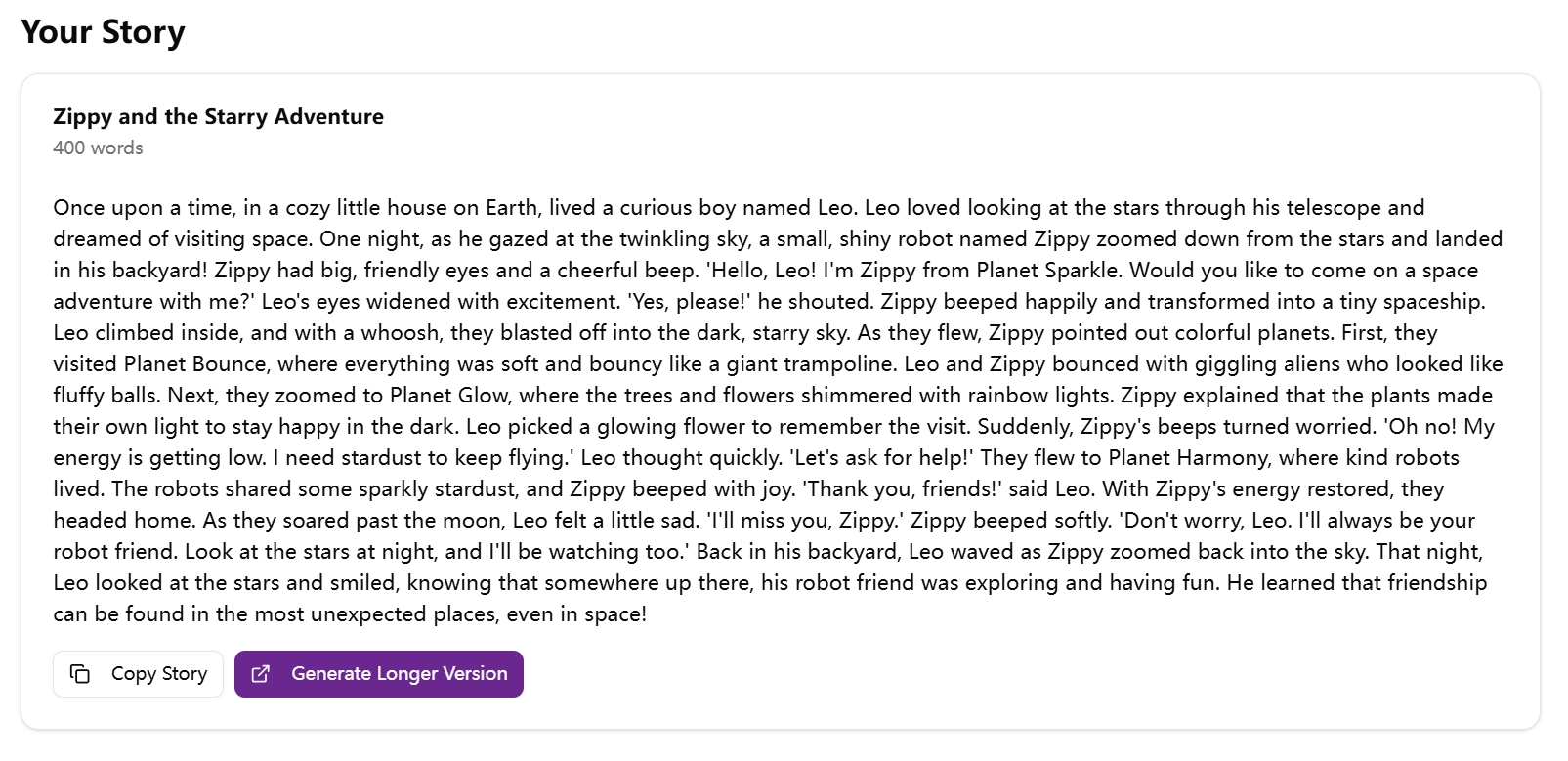
Move this result into the next focused tool instead of starting over.
How the Middle School Story Generator Works
Create an age-appropriate story for readers aged 10 to 14 in three steps.
Pick a genre
Choose friendship, mystery, adventure, or another genre from the list.
Add keywords
Add terms like school, sports, or family to shape the story.
Generate your story
Get a complete story with relatable characters and stakes that respect tweens.
Why Choose This Generator
Age-Appropriate Stories
Every story keeps vocabulary, themes, and stakes right for ages 10 to 14 — real tension without adult content.
Relatable Characters
Protagonists who text in lowercase, get stage fright, and face problems that feel exactly like a real middle schooler's.
Classroom-Ready Length
Most stories run a few hundred words — long enough for a full beginning, middle, and end, short enough for one sitting.
A Scaffold for Young Writers
Reluctant writers can continue, rewrite, or remix a generated story until it becomes their own.
Who It Is For
Teachers
Generate a fresh story for reading comprehension, narrative-writing mentor texts, or a discussion starter students actually want to finish.
Parents
Offer a short, age-appropriate tale that treats a tween seriously — no talking down, no baby talk, just a story worth reading.
Young Writers
Start from a generated beginning instead of a blank page, then change the characters and settings until the story feels yours.
Stories That Speak Directly to Middle Schoolers
Middle schoolers can smell a lecture from the first paragraph. They want stories that take their friendships, embarrassments, and daydreams seriously — a joke that lands, a problem that feels unfair, and characters who sound like actual twelve-year-olds. A middle school story generator tuned for this age avoids both baby talk and precocious mini-adults.
- Take friendships, embarrassments, and daydreams seriously, not as lessons
- Write characters who sound like actual twelve-year-olds, not miniature adults
- Avoid both baby talk and precocious mini-adults entirely
Age-Appropriate Stakes for Ages 10 to 14
The stakes that hook a middle schooler feel enormous even when they look small: making the team, saving a friendship, being believed, keeping a secret. High stakes don't require body counts — they require a character with something real to lose, facing challenges a kid can picture.
- Use stakes like making the team or saving a friendship
- Trade graphic violence for challenges kids can picture facing
- Give the character something real to lose, not a body count
Characters a Middle Schooler Will Recognize
Relatable characters aren't generic — they're specific. A protagonist obsessed with a niche hobby, who gets stage fright before a presentation, who texts in lowercase but talks big in their head, connects faster than a bland every-kid. Middle school readers want their own contradictions reflected.
- Make protagonists specific and distinct, not a bland every-kid
- Reflect contradictions like brave one minute, mortified the next
- Give supporting characters their own loneliness and strain
Short Stories That Work in the Classroom
Teachers need stories that fit a period, spark discussion, and model a skill. A tight three-hundred-to-five-hundred-word story works for a warm-up read, a comprehension check, or a mentor text for narrative writing. The best classroom stories end at a decision point so students can argue what happens next.
- Keep stories short enough for a warm-up or comprehension check
- End at a decision point so students can argue what happens next
- Demonstrate one clear technique a class can copy
Inspiring Reluctant Young Writers
Reluctant writers usually aren't out of ideas; they're out of confidence. Starting from a blank page is the hardest part, so hand them a beginning they can build on. A generated story becomes a scaffold they can continue, rewrite, or remix until it feels theirs.
- Hand them a beginning to remove the blank-page panic
- Let them continue, rewrite, or remix until it feels theirs
- Praise specifics like how a character talks to build momentum
Realistic Dialogue
Tween dialogue is quick, overlapping, and full of inside jokes. Characters interrupt, deflect with humor, and rarely say exactly what they mean. Reading dialogue aloud is the fastest way to catch lines that sound like an adult wrote them. Let one kid be dry and sarcastic, another earnest, another a nervous over-sharer.
Friendship Stories
Friendship is the great middle school subject. The drama of shifting loyalties, the relief of a best friend who gets it, the guilt of outgrowing someone — these land harder than any quest. Good friendship stories show loyalty tested and repaired, not just asserted. Give the characters a shared history and a current strain.
Light Mystery and Adventure
Mysteries and adventures give tweens agency, which is why they devour them. A missing object, a secret room, a rumor that turns out true — the stakes are exciting without being disturbing. Let the young characters solve problems with their own cleverness rather than adult rescue. The appeal is competence: a kid figuring things out.
Writing Prompts for Class
Prompts that work best give students a situation, not a theme: 'your locker starts leaving you notes' beats 'write about friendship.' Concrete, slightly strange prompts lower the bar for starting. Let students change any element they want — the prompt is a launchpad, not a rule. Collect the strongest openings and read a few aloud.
See What a Middle School Story Generator Creates
Real age-appropriate stories for tweens — here's what a typical run returns.
Frequently Asked Questions
Explore More Story Tools
Ready to Create a Middle School Story?
Create an age-appropriate story that respects readers 10 to 14 — with 20 free credits on signup.










































 Featured on AI Ranking









 Just Hunt