
Movie Story Generator - Create Cinematic Tales Instantly
Write scenes a director can actually see — visual, economical, and built on structure that holds.
Leave blank for random movie story ideas.
Comma-separated; helps the movie story generator focus.
Please sign in to use this movie story generator.
First-time visitors can generate 1 result for free, no sign-in required. Credits are only needed after the free trial.
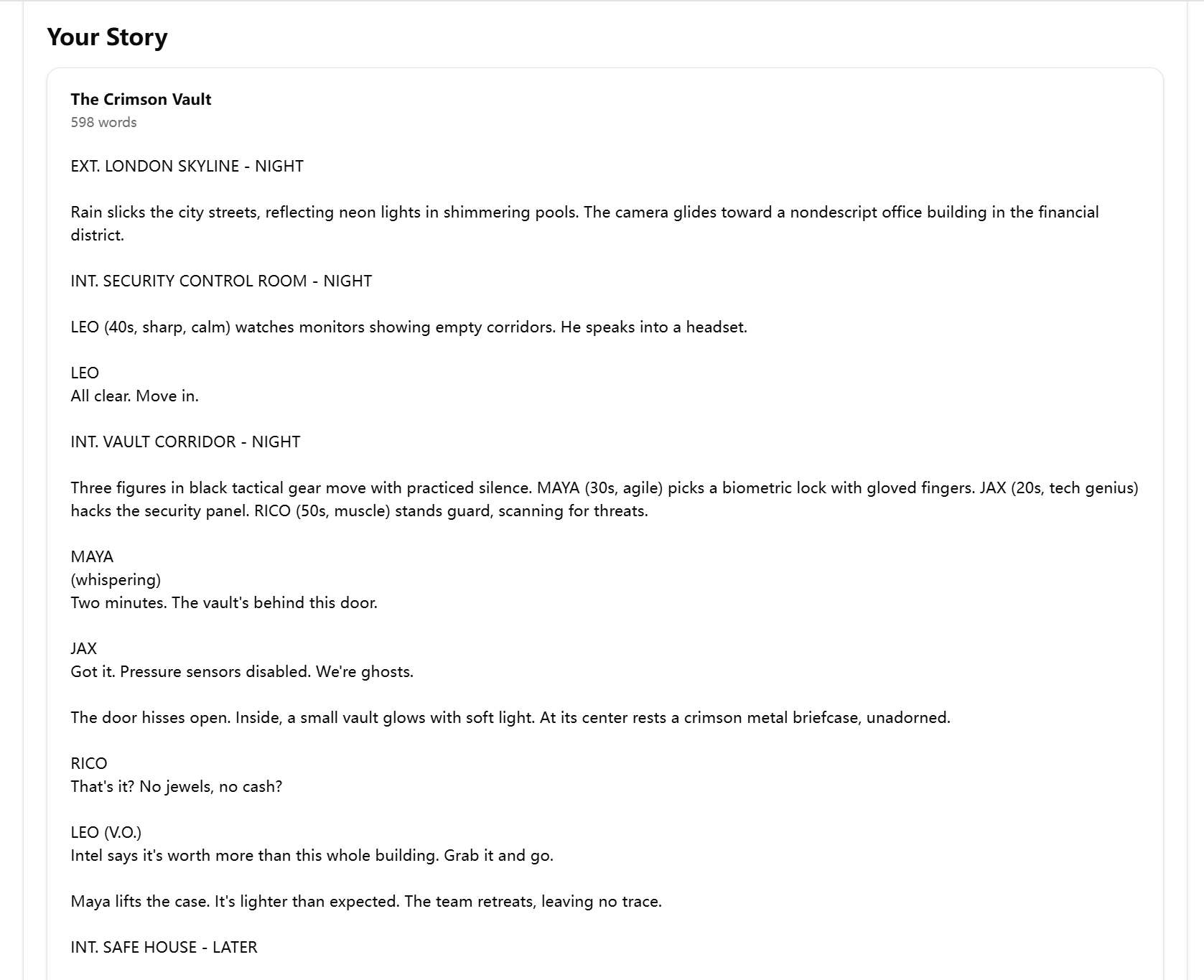
This sample shows the output style and structure this tool can generate.
Move this result into the next focused tool instead of starting over.
How the Movie Story Generator Works
Turn a premise into a cinematic story with structure and scenes in three steps.
Describe your idea
Enter a movie story idea, or leave it blank for a random cinematic premise.
Add keywords
Add terms like action, romance, thriller, comedy, or drama to set the genre.
Generate your story
Get a visual narrative with three-act structure, scenes, and dialogue a director can see.
Why Choose This Generator
Visual, Shottable Scenes
Every scene gives characters something to do — pacing, building, lying with their hands — so the action carries the emotion.
Three-Act Structure
Get a setup, confrontation, and resolution with a midpoint reversal that reframes the first half and powers the second.
Speakable Dialogue
Lines survive being said out loud — short, oblique, and full of subtext the camera can show.
Pitch-Ready Loglines
Draft who, want, obstacle, and stakes in a sentence you can test against a poster and a trailer.
Who It Is For
Screenwriters
Prototype a plot as prose first, then translate the beats and dialogue into screenplay format scene by scene.
Short-Film Makers
Sketch a self-contained story with strong locations and minimal cast that you can shoot on a tight schedule.
Pitching Writers
Generate several premises, test each against the poster-and-trailer question, and keep the one someone would pay to see.
From Story Idea to Screen: Structure Basics
A movie story is told in pictures and scenes, which changes how you build it. Where a novel can spend a page inside a character's head, a film must show thought through action, expression, and setting. A movie story generator can turn a loose premise into a visual sequence you could storyboard.
- Show a character's thoughts through action, expression, and setting
- Turn a premise into an opening image, a turning point, and a climax
- Make the premise specific enough to storyboard shot by shot
Three-Act Structure Explained Without the Fluff
Three acts are setup, confrontation, and resolution wearing a suit. Act one establishes the world and the want; act two is the long middle where things get worse; act three forces a final confrontation and shows the change. Keep raising the cost of each choice, especially in the sagging middle.
- Establish the world and the want before the point of no return
- Keep raising the cost of each choice through the long middle
- End act three with a confrontation that shows the change
Writing Scenes That Visualize Beautifully
A strong scene is one a director can shoot without asking what anyone is thinking. Give characters something to do — pacing, building, repairing, lying with their hands — and let the action carry the emotion. If a scene could be cut without losing anything, cut it.
- Give characters physical actions that carry the emotion
- Describe what the camera would catch — a pause, a glance, a disarrayed room
- Cut any scene that could be removed without losing anything
Screen Dialogue vs Prose Dialogue
Screen dialogue is spoken, so it has to survive being said out loud. It's shorter, more oblique, and full of people talking past each other rather than stating themes. Cut the exposition a narrator would have carried, and let subtext leave room for the actor and the image.
- Write dialogue that survives being spoken aloud by an actor
- Cut exposition and let behavior carry the meaning
- Let subtext leave room for the actor and the image
Pitch-Ready Movie Ideas in a Few Minutes
A pitch needs a logline: who, what they want, what's in the way, and what's at stake — all in a sentence or two. Test each premise by asking whether you can picture the poster and the trailer. If it survives those two images, it has a spine.
- Compress who, want, obstacle, and stakes into one sentence
- Test each premise against the poster-and-trailer question before developing it
- Compare several ideas and keep the one someone would pay to see
The Logline
A logline compresses the whole movie into one sentence: a protagonist, a goal, an obstacle, and stakes. Strong versions are specific — 'a grieving puppeteer tries to revive his dead son' tells you more than 'a man confronts loss.' The sharpest one usually names the emotional hook, not just the plot.
The Midpoint Reversal
The midpoint is where the story turns — a revelation, a loss, a betrayal that changes the protagonist's goal. It reframes the first half and powers the second. Done well, it raises the stakes without feeling like a twist for its own sake. Ask what your character believes that the midpoint can overturn.
Show, Don't Tell
In film, 'show, don't tell' is literal: the audience believes what it sees, not what characters say. Replace 'he was sad' with a scene — an untouched plate, a voicemail played twice. Let actions contradict or confirm the dialogue. When image and word agree, the moment lands; when they diverge, the audience leans in.
Genre Beats
Each genre carries promises the audience expects kept: the horror needs a scare, the comedy needs a laugh, the romance needs a first kiss. Know your genre's beats and deliver them — but at unexpected moments. Subverting a beat works only if you first understand why it exists. Genre is the rhythm the audience came for.
See What a Movie Story Generator Creates
Real cinematic stories with visual scenes — here's what a typical run returns.
Frequently Asked Questions
Explore More Story Tools
Ready to Draft Your Movie Story?
Build a cinematic story with visual scenes and three-act structure — with 20 free credits on signup.












































 Featured on AI Ranking










 Just Hunt