
Horror Story Plot Generator
Plan a story that builds dread from the first scene to a final reveal readers can't forget.
Separate multiple keywords with commas
Please sign in to use this tool
First-time visitors can generate 1 result for free, no sign-in required. Credits are only needed after the free trial.
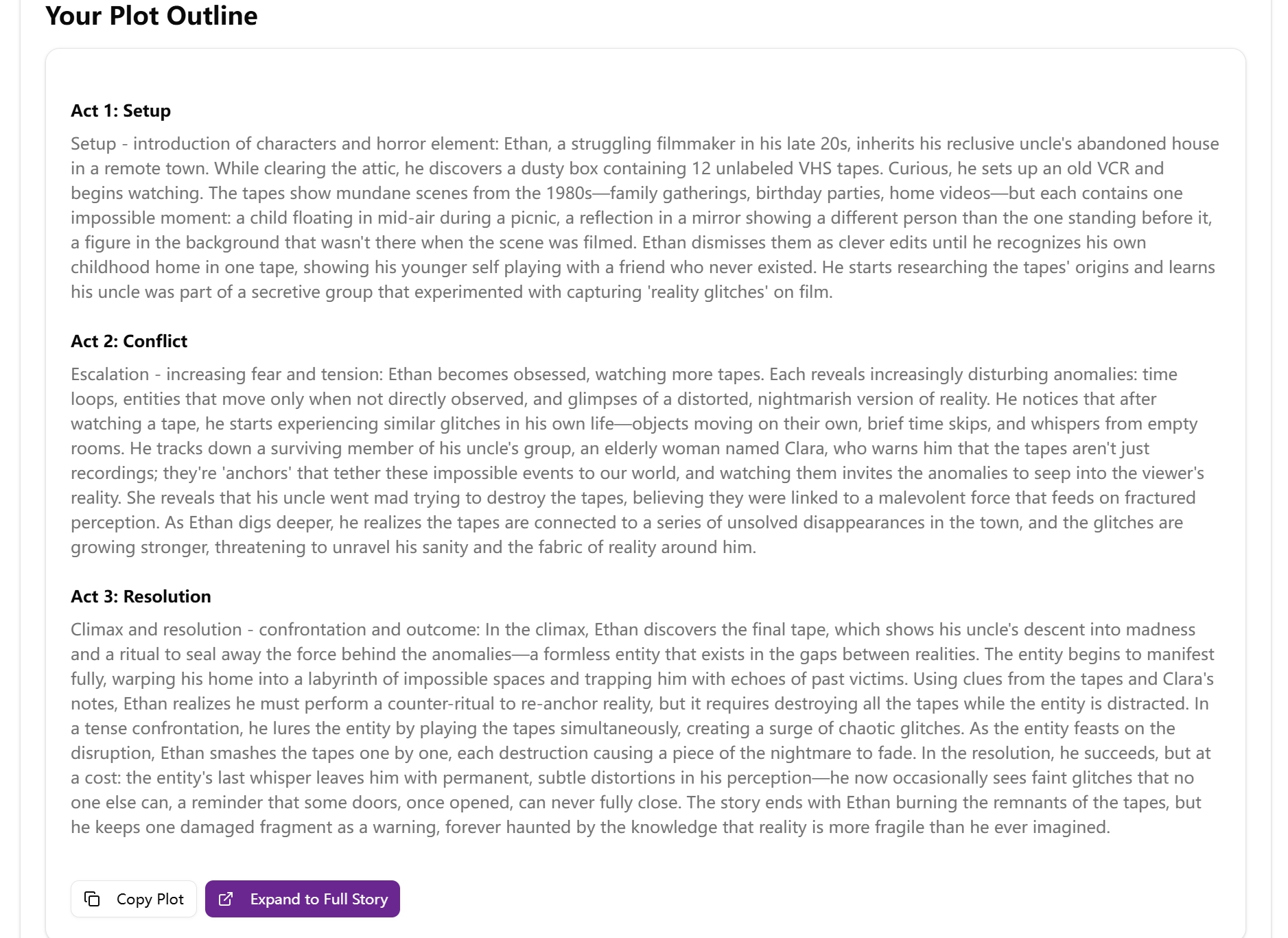
This sample shows the output style and structure this tool can generate.
Move this result into the next focused tool instead of starting over.
How the Horror Story Plot Generator Works
Turn a seed idea into a structured horror outline in three quick steps.
Describe your idea
Enter a story idea, or leave it blank for a random dread-filled premise.
Add keywords
Add terms like ghost, psychological, or supernatural to steer the tone.
Generate your plot
Get a structured outline with inciting dread, rising tension, and an ending that haunts.
Why Choose This Generator
Structured Plot Outlines
Every run returns a full skeleton — inciting dread, a midpoint twist, and a climax — so you never start from a blank page.
Subgenre Control
Steer the tone with keywords like psychological, slasher, folk horror, or cosmic, and get a structure matched to that rhythm.
Endings That Haunt
Choose a bleak final image or a survivor's escape, and shape a reveal that lingers long after the last page.
Expand to Full Story
Like a generated outline? Expand any beat into complete prose with the full story tool in one click.
Who It Is For
Horror Short-Fiction Writers
Draft a plot for a flash piece or anthology call, then revise the beats to fit your word limit and the publication's tone.
Slasher and Supernatural Authors
Build layered threats — the thing in the basement, the town that won't help, the guilt inside — so each escape tightens the noose.
Game Masters and Screenwriters
Sketch a single-location dread or a slow-burn arc you can adapt into a one-shot scenario, a short film, or a script.
Plot Structures That Genuinely Terrify
Horror lives or dies on structure: a slow spiral moves differently from a chase, and a haunted-house plot needs a different skeleton than a psychological unravelling. A horror story plot generator gives you a spine, not a straitjacket — an inciting dread, a midpoint where the rules change, and a third act that forces a confrontation.
- Pace escalation steadily so dread builds before anything visibly attacks
- Anchor each plot with inciting dread, a rule-changing midpoint, and a forced confrontation
- Match the skeleton to the subgenre rather than forcing one shape on every tale
From Quiet Setup to Shocking Reveal
Most horror drafts waste their first scenes. The strongest open on something ordinary — a routine, a family, a job — and let the wrongness creep in at the edges: a door left open, a photo that changes, a sound the character can't place. Stack small irregularities until the reveal feels inevitable in hindsight.
- Open on an ordinary world so the reader first believes it is safe
- Introduce wrongness at the edges before it becomes undeniable
- Stack small irregularities so the shocking reveal lands as inevitable
Plot Devices That Keep Tension Alive
Tension is renewable if you know which devices produce it. A ticking clock turns dread into urgency; a kept secret invites complicity; an unreliable narrator makes every reassurance suspect. Rotate these devices rather than leaning on one until it goes dull.
- Turn passive dread into urgency with a concrete ticking clock
- Let a secret the protagonist keeps make the reader complicit
- Rotate devices so no single source of tension wears itself out
Layering Threats for Maximum Dread
A single monster gets familiar; layered threats never do. Combine the immediate danger with a systemic one — a town that refuses to help — and an internal one, like guilt or denial. Each threat should feed the others, so escaping one tightens another. The horror story plot generator can suggest how all three braid into one tightening noose.
- Stack an immediate threat, a systemic one, and an internal one
- Make each danger feed the others so escaping one tightens another
- Let supernatural horror, betrayal, and personal failing braid into a single noose
Choosing an Ending That Haunts
An ending should linger for reasons the plot already earned. The bleak final image works when the story has been about hopelessness; the survivor's escape works when it has been about resilience. Answer the central question, and leave one thread slightly loose to recontextualize everything.
- Match the ending to what the story has been about
- Answer the central question instead of merely shocking
- Leave one loose thread that recontextualizes earlier scenes
- Avoid endings that announce a sequel or explain the monster into harmlessness
The Three-Act Slow Burn
A slow-burn plot lets dread accumulate before anything visibly attacks. Act one establishes a normal world and a first small wrongness; act two raises the stakes as the character investigates; act three forces a confrontation. Keep the escalation steady — each reveal slightly worse than the last — so the climax feels like a release the audience has been bracing for.
Unreliable Narrators
An unreliable narrator makes the reader question every sentence. The narrator might be lying, mistaken, or losing their grip, and horror thrives on that uncertainty. Use the device sparingly: drop one contradiction per act, never a wall of them. The goal is doubt that compounds, so the final reveal makes earlier scenes read differently.
Ticking-Clock Devices
A deadline forces characters to act before they're ready. It can be literal — a ritual at midnight — or emotional, like a loved one slipping away. The clock works because it converts abstract fear into a concrete countdown. Pair it with an obstacle that slows the protagonist, and each page turn feels like time running out.
Single-Location Horror
Confining a story to one place amplifies dread by removing escape. A house, a cabin, a locked ward — the setting becomes a character with its own rules. Single-location horror is also easier to write and film, which suits short fiction. Let the space reveal its secrets slowly so the audience learns its geography the way the characters do.
See What a Horror Story Plot Generator Creates
Real outlines from real writers — here's what a typical run returns.
Frequently Asked Questions
Explore More Story Tools
Horror Story Idea Generator
Find a premise worth scaring your readers with
Try Horror Story Idea GeneratorReady to Generate Your Horror Story Plot?
Turn a seed idea into a structured outline that builds dread from the first scene — and start with 20 free credits on signup.












































 Featured on AI Ranking










 Just Hunt