Interactive Story Generator - Create Choose Your Own Adventure Tales
Branching choices, real consequences, and endings that feel earned — build a story your readers shape as they go.
Leave blank for a random interactive story.
Leave blank for random genre.
Please sign in to use this interactive story generator.
First-time visitors can generate 1 result for free, no sign-in required. Credits are only needed after the free trial.
This sample shows the output style and structure this tool can generate.
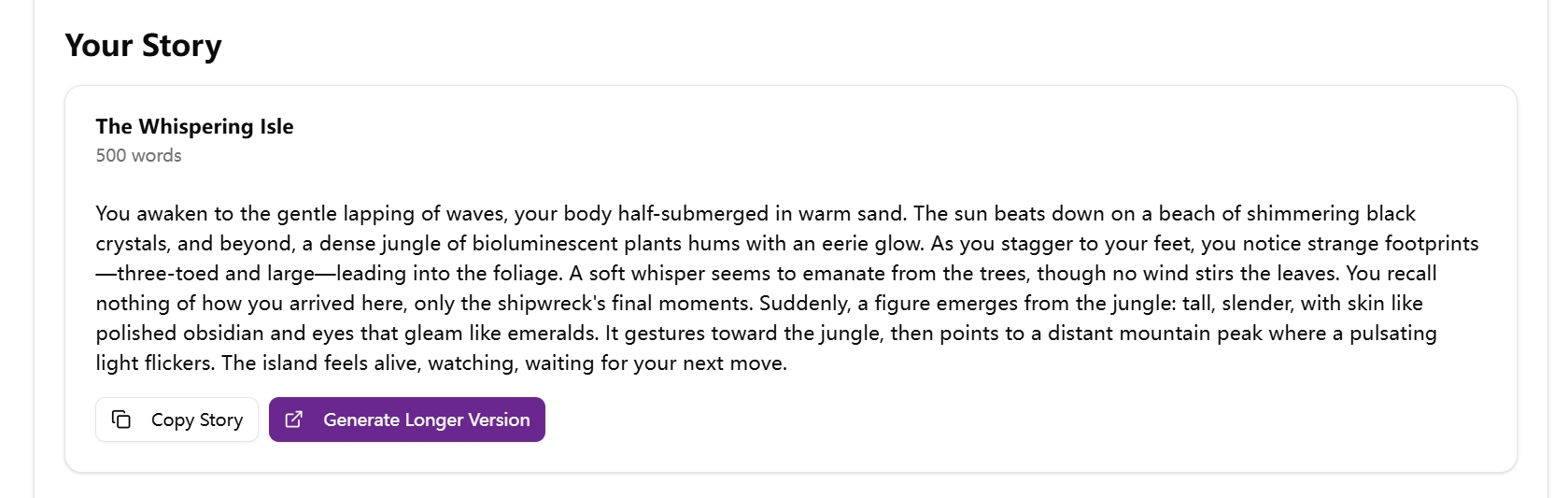
Move this result into the next focused tool instead of starting over.
How the Interactive Story Generator Works
Turn a premise into a branching story with choices and endings in three steps.
Describe your concept
Enter a story concept, or leave it blank for a random adventure.
Pick a genre
Choose fantasy, sci-fi, mystery, or another tone for your branching tale.
Generate your story
Get a story with choice points and multiple endings your readers can shape.
Why Choose This Generator
Branching Choice Points
Every decision forks the plot, so choices change who lives, what the character learns, and how the world responds.
Multiple Endings
Define two to five outcomes — a reunion, an escape, a sacrifice — and let different paths lead to each one.
Genre Support
Steer the tone with fantasy, sci-fi, or mystery so the branching structure matches the story you want to tell.
Game-Ready Prototypes
The output maps naturally onto text adventures and visual novels, so you can test a dialogue tree before committing to code.
Who It Is For
Choose-Your-Path Authors
Sketch a shared opening, plant three to five meaningful choices, and route every branch toward an ending that feels earned.
Teachers and Classrooms
Turn reading into a decision-making exercise — students argue about what happens next, defend their choice, and reread to find a better path.
Game Designers
Prototype dialogue trees and narrative systems for text adventures or visual novels before you invest time in code.
What Makes a Story Interactive
Interactivity is more than letting the reader pick a door. A story becomes interactive when a choice changes something real — who lives, what the character learns, how the world responds. A strong interactive story generator treats every decision as a fork with consequences that ripple forward, not a detour that snaps back.
- Make every choice change something real about who lives or what is learned
- Treat each decision as a fork with consequences that ripple forward
- Avoid cosmetic detours that snap back to a single rail
Branching Narratives: Choices That Actually Matter
A branch is only worth writing if the two paths diverge in ways readers can feel. Keep a core spine fixed and let choices reshape scenes, allies, and dangers. Before adding a branch, ask what the reader would regret not choosing — if both options lead to the same beat, cut one.
- Keep a fixed spine and let choices reshape scenes and allies
- Ask what the reader would regret not choosing before adding a branch
- Cut any choice where both options lead to the same beat
Writing for Multiple Endings Without Chaos
Multiple endings multiply your drafting surface, so define them early — usually two to five — and route every branch toward one. Track a few variables like trust, courage, or survival, and let the ending read whichever threshold the reader crosses.
- Define two to five endings before the branches multiply
- Track variables like trust, courage, or survival to keep endings coherent
- Route every branch toward a defined ending instead of endless permutations
Interactive Stories in Classrooms and Games
Teachers use these stories to turn reading into a decision-making exercise: students argue about the next move, defend their choice, and reread for a better path. Game designers use the same structures to prototype text adventures and visual-novel dialogue trees before committing to code.
- Let students argue, defend, and reread to find a better path
- Use the output as a lesson plan, a game script, or a writing prompt
- Prototype dialogue trees for games before committing to code
Planning Your Own Choose-Your-Path Story
Begin with the ending you most want, then work backward. Decide the emotional question — Will she trust again? Can he escape? — and build three or four junctions where the reader answers it. You need enough structure that no choice dead-ends into nothing.
- Start from the ending you want and work backward
- Build three or four junctions around a single emotional question
- Label what each exit costs or reveals so no choice dead-ends
Branching Structure Basics
Most interactive stories use a hub-and-spoke shape: a shared opening, a few choice points, and paths that reconverge before the next fork. Reconvergence keeps the word count sane while still honoring each decision. Save permanent branches for the climax, where diverging endings have room to land. The shape should stay simple enough to sketch on one page.
Choice Design
Good choices are specific, tempting, and uneven. 'Run or hide' beats 'continue or wait' because the tradeoffs are legible. Every option should promise something the others can't deliver, whether safety, truth, or a relationship. Avoid fake choices that lead to the same outcome; readers resent them and replay value collapses.
Tracking Variables
A small state system keeps endings coherent. Pick two to four values — courage, trust, time, resources — and let each choice shift them. The final scene checks those totals to pick an ending. This mechanical backbone is invisible to readers but keeps a branching story from contradicting itself as paths multiply.
Ending Design
Plan endings that feel earned by the choices, not random. Each should reflect a distinct answer to the story's central question — trust or isolation, survival or sacrifice. Tie at least one ending to the reader's earliest decision so replaying reveals new meaning. Endings are what readers remember, so spend real effort there.
See What an Interactive Story Generator Creates
Real branching stories with choices that matter — here's what a typical run returns.
Frequently Asked Questions
Explore More Story Tools
Ready to Build Your Interactive Story?
Create branching choices and endings your readers shape as they go — with 20 free credits on signup.












































 Featured on AI Ranking










 Just Hunt