Story Conflict Generator - Create Compelling Story Tensions
Find the struggle that drives your plot, internal, external, and everything in between.
Leave blank for random conflict ideas.
Comma-separated; helps the story conflict generator focus.
Please sign in to use this story conflict generator.
First-time visitors can generate 1 result for free, no sign-in required. Credits are only needed after the free trial.
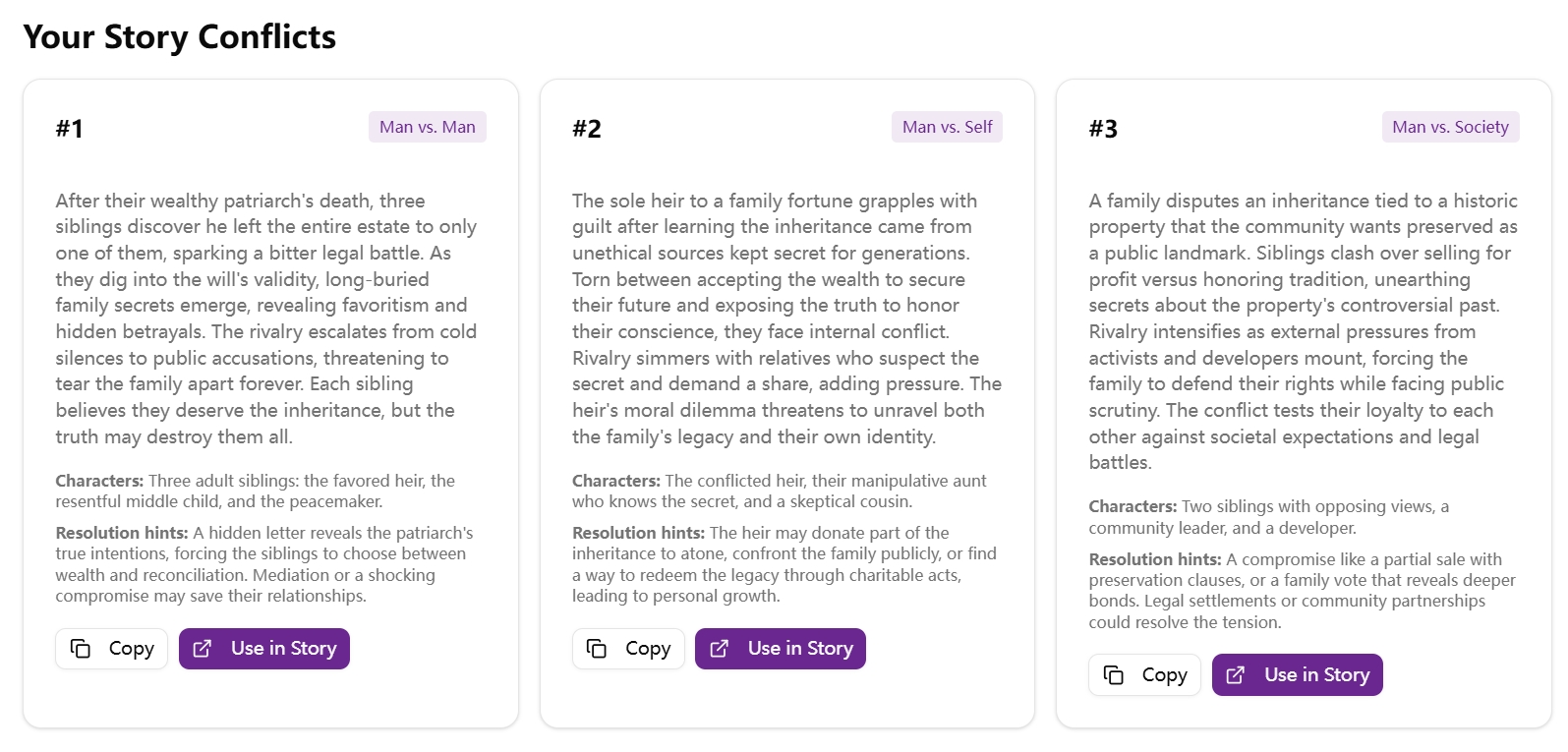
This sample shows the output style and structure this tool can generate.
Move this result into the next focused tool instead of starting over.
How the Story Conflict Generator Works
Three quick steps turn a vague plot problem into a struggle that drives the whole story.
Add an idea or theme
Drop in a premise, or leave it blank for a random conflict.
Pick a genre
Select a genre so the conflict fits the story you're telling.
Generate the struggle
Create conflicts for one credit, then shape them into a full plot.
Why Choose This Generator
All four conflict types
This story conflict generator covers person, self, nature, and society, so you can find the struggle your plot actually needs.
Internal and external
Get both the outer obstacle and the inner doubt, braided together so the external pressure makes the internal struggle worse.
Stakes you can raise
Start with a clear want and obstacle, then escalate what the character stands to lose as the story moves forward.
Genre matched
Conflicts come tuned to the genre you pick, from survival to romance to mystery, so the struggle fits the world you're building.
Who It Is For
Novelists stuck mid-outline
When a plot stalls, drop in the premise and pull a conflict that gives the middle of the book something to push against.
Screenwriters and game designers
A clear want-versus-obstacle engine keeps scenes tense and gives players or viewers a reason to stay invested.
Short story writers
One well-chosen conflict can carry a whole short piece, giving a single scene the tension a novel would spread across chapters.
The Four Types of Story Conflict
Most stories turn on one of four struggles: a person against another person, against themselves, against nature or circumstance, and against society or a system. Person-versus-person gives you the cleanest engine; person-versus-self is quieter but often more memorable. This story conflict generator is most useful when you know which type you're after, because each one changes the pacing, the antagonist, and the ending.
- Match your struggle to person, self, nature, or society
- Know which type you need before choosing a conflict
- Expect each type to change pacing, antagonist, and ending
Conflict vs Drama: What Actually Moves a Plot
Argument isn't conflict. Two characters shouting at each other can be pure noise if nothing is actually at stake, while a single unopened letter can carry enormous tension. Conflict is want versus obstacle, with a real cost for failing. Drama is the surface noise that substitutes for the real thing. Before you write the shouting match, name what each character wants and what they'll lose.
- Define conflict as a want blocked by an obstacle, with a cost
- Treat shouting and tears as drama, not real conflict
- Name what each character wants and what they stand to lose
Weaving Internal and External Conflict
The strongest stories braid the two together so each makes the other worse. External conflict, like the rival, the storm, or the deadline, forces the character to act. Internal conflict, like fear, guilt, or divided loyalty, makes every action cost something. Put a decision where the two strands meet, and let external pressure tighten while internal doubt keeps the character from acting cleanly.
- Pair an external obstacle with an internal struggle
- Let each strand make the other one worse
- Place a decision where the two conflicts meet
Raising the Stakes Mid-Story
Stakes go stale if they stay the same size, so escalate what the character can lose as the story moves. Raise them in layers: first the job, then the friendship, then the sense of self. Each turn should make the previous position impossible to return to. The best raise isn't always bigger danger; it's more personal cost.
- Escalate what the character can lose in layers
- Make each turn close off the previous position
- Prefer personal cost over bigger and more abstract danger
Resolving Conflict Without Cheap Tricks
A satisfying ending resolves the conflict in a way the character earned, not in a way that rescues them. Deus ex machina, the sudden inheritance, the convenient confession, robs the story of its meaning because the character's choices stopped mattering. Instead, let the resolution grow from a decision made under pressure, one that costs the character something they'd been holding onto.
- Resolve through a decision the character earned under pressure
- Steer clear of rescues, coincidences, and sudden confessions
- Make the ending cost the character something they held onto
Person vs Person
The cleanest conflict is two characters who want mutually exclusive things. Make both wants sympathetic so the reader feels the pull of each side. A rival who is merely evil is forgettable; a rival who is right about one thing forces the protagonist to genuinely struggle.
Person vs Self
Internal conflict lives in the gap between what a character believes and what they're about to do. Put a decision in front of them that forces the two into collision, like the honest answer that costs a friendship. The fight happens in the hesitation.
Person vs Nature
Survival stories strip away negotiation and leave the character against cold, water, time, or distance. The conflict is less about defeating nature than about enduring it. Keep the threat impersonal and patient; nature doesn't gloat or explain, which makes it uniquely relentless.
Person vs Society
Here the antagonist is a rule, a law, or a crowd. The character fights a system larger than any individual, and winning usually means changing one mind or one corner of the world rather than toppling everything. Give the system a human face so the abstract stakes feel personal.
See What It Creates
Each run returns a clear, ready-to-use conflict with the stakes built in.
Frequently Asked Questions
Explore More Story Tools
Find Your Story Conflict Now
Generate a high-stakes story conflict in seconds — 20 free credits on signup.











































 Featured on AI Ranking










 Just Hunt