
Story Plot Generator
Turn a single idea into a working plot outline with setup, conflict, and a satisfying resolution.
Please sign in to use this tool
First-time visitors can generate 1 result for free, no sign-in required. Credits are only needed after the free trial.
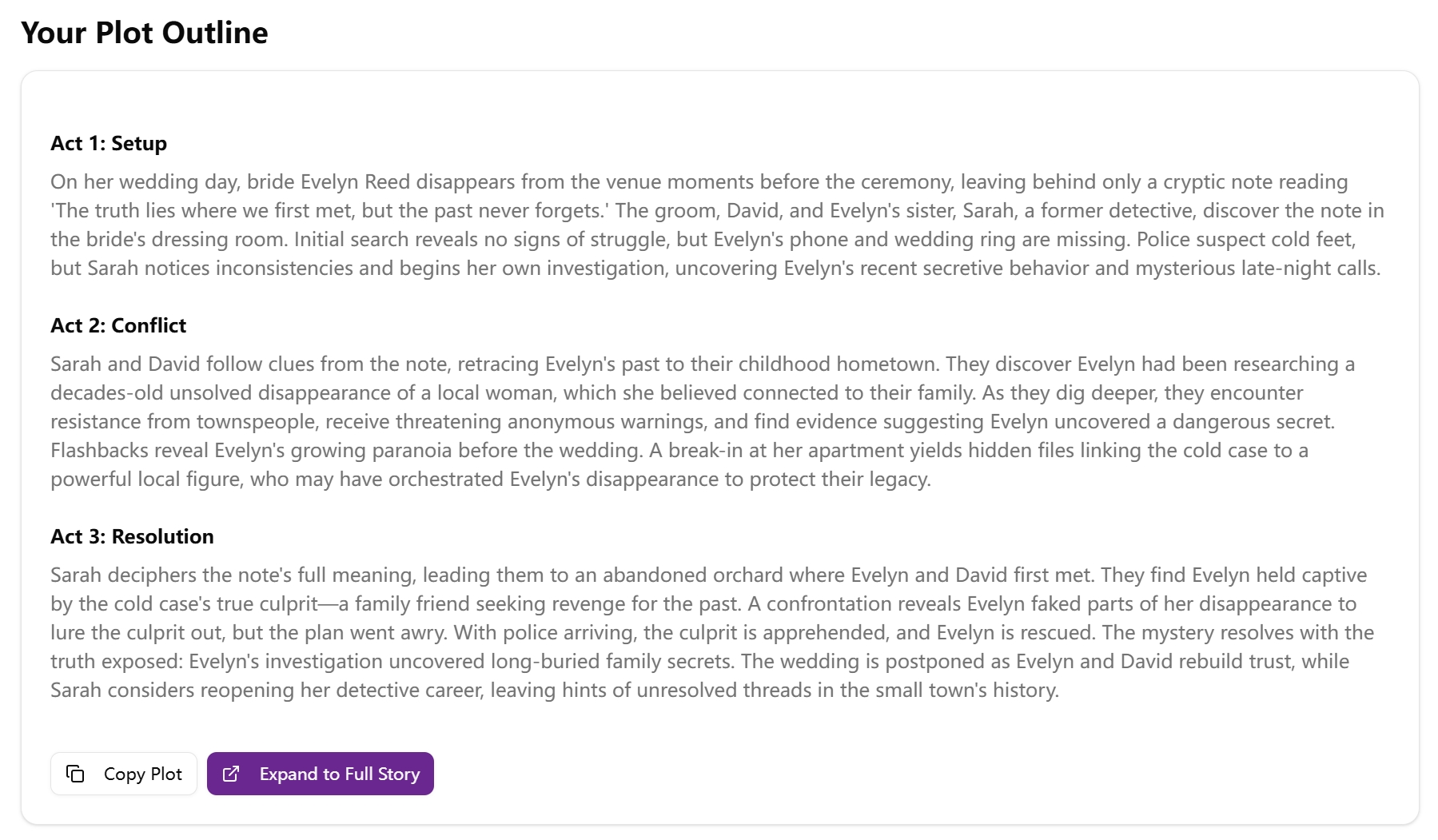
This sample shows the output style and structure this tool can generate.
Move this result into the next focused tool instead of starting over.
How the Story Plot Generator Works
Turn a single idea into a working plot outline in three quick steps.
Enter your story idea
Type a one-line idea, or start from a character, a question, or an image.
Choose your genre
Pick a genre so the beats, stakes, and pacing match what readers expect.
Generate the plot
Get a setup, conflict, and resolution with key turning points, ready to draft.
Why Choose This Generator
Complete Plot Outlines
The story plot generator turns one idea into a full setup-conflict-resolution arc, so you can see the shape before you write.
Classic Story Structures
Try the three-act, hero's journey, Fichtean curve, and seven-point structures side by side.
Plot Hole Checks
State causes and effects plainly so you catch missing motivations and coincidences early.
Draft-Ready Output
Expand any plot into finished prose with a connected full-story generator when you're ready.
Who It Is For
First-time novelists
Start with one spark and watch it become a working arc, so the fear of the blank page stops blocking your draft.
Genre writers and fans
Shape beats, stakes, and pacing to fantasy, romance, mystery, or horror so your plot lands with the right readers.
Teachers and writing groups
Demonstrate how goal, conflict, and resolution fit together, and give students a structure they can build on.
The Anatomy of a Plot
Every plot shares a spine: a character wants something, obstacles get in the way, and the struggle changes them. Strip a story to those parts — goal, complication, crisis, resolution — and it almost writes itself. When a scene feels flat, it's usually because one part is missing. A story plot generator names those parts out loud.
- Name the goal, complication, crisis, and resolution before drafting
- Check a flat scene against the parts it's missing
- Let the character's want drive every obstacle you add
Classic Plot Structures You Can Use Today
The three-act structure splits your story into setup, confrontation, and resolution. The hero's journey maps a character's growth across twelve familiar stages, while the Fichtean curve stacks rising crises toward a climax. None is a formula you must obey — they're scaffolding you can lean on.
- Compare three-act, hero's journey, and Fichtean curve shapes
- Use a structure as scaffolding, not as a rulebook
- Match the shape to the pacing your genre expects
Plotting Without Choking Your Creativity
Some writers worry a plan will flatten the story's surprises. The trick is to plot the direction, not every footstep — decide the destination and the big turns, then let the small moments surprise you. Structure should free your imagination by removing the fear of getting lost.
- Decide the destination and big turns, not every footstep
- Leave room to swerve, add a subplot, or reverse an ending
- Plan less than you think you need; you can always add more
Turning a Single Idea into a Full Plot
Almost every strong plot starts as one small spark: a character, a question, or an image. Stretch it by asking who wants what, and why now. Then ask what stands in their way, and what they'd lose by failing. Answer those three questions and you have a working arc.
- Start from a character, a question, or a single image
- Ask who wants what, what blocks them, and what failure costs
- Answer all three questions to build a working arc
Plot Holes and How to Catch Them Early
Plot holes hide in the spaces between scenes — a character who knows too much, a rule you forgot, a coincidence doing the hero's work. Catch them by reading your outline backward, or by asking 'why not?' after every decision. Fix the logic before you write the prose.
- Read the outline backward to spot what doesn't connect
- Ask 'why not?' after every decision your characters make
- Fix causes and effects before drafting the prose
Three-Act Structure
Setup, confrontation, resolution. Act one introduces the goal, act two escalates the obstacles, act three pays it off. It's the default shape for good reason: it mirrors how tension naturally rises and releases.
Hero's Journey
A call to adventure, mentors, trials, and a return changed. It maps internal growth alongside external action, which makes it ideal for fantasy, quests, and coming-of-age stories.
Fichtean Curve
Skip the slow setup and stack crises one after another until the climax. It keeps readers breathless, which is why thrillers and horror lean on it.
Freytag's Pyramid
Exposition, rising action, climax, falling action, denouement. A literary classic that gives tragedy and character studies room to breathe.
Seven-Point Story Structure
Hook, plot turn one, pinch point, midpoint, pinch point two, plot turn two, resolution. A practical, modern checklist that works well for novels.
See What It Creates
A structured plot outline with clear turning points, ready to expand.
Frequently Asked Questions
Explore More Story Tools
Map Your Plot with a Story Plot Generator
Turn one idea into a complete setup-conflict-resolution arc in seconds — get 20 free credits on signup.












































 Featured on AI Ranking










 Just Hunt