
Horror Story Generator
Generate horror that unsettles through suspense and dread rather than cheap scares — one credit per tale.
Separate multiple keywords with commas
First-time visitors can generate 1 result for free, no sign-in required. Credits are only needed after the free trial.
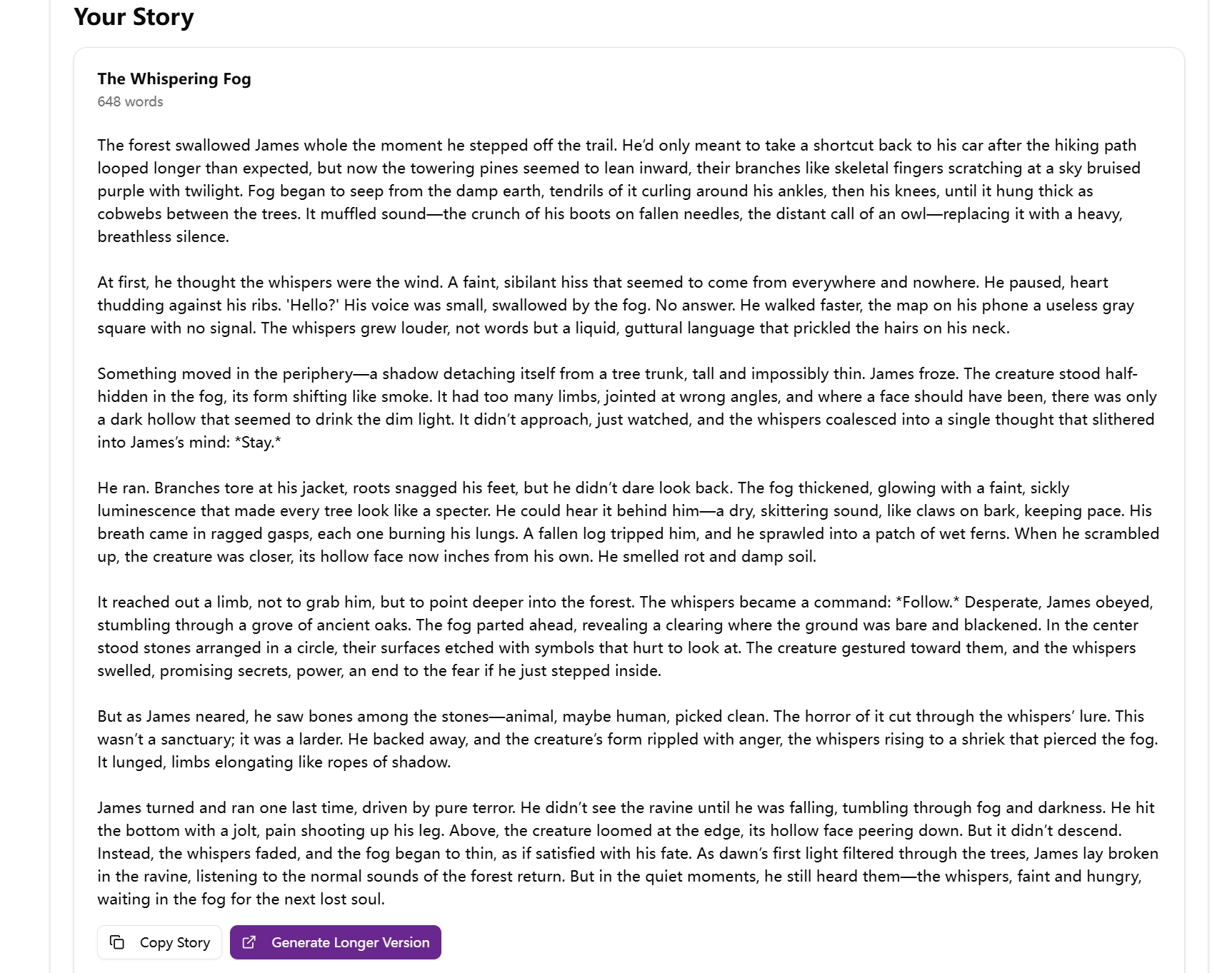
This sample shows the output style and structure this tool can generate.
Move this result into the next focused tool instead of starting over.
How the Horror Story Generator Works
A dread-filled tale assembles itself in three steps.
Choose a subgenre
Pick psychological, supernatural, gothic, or another mode to set the source of the fear.
Add keywords
Steer the tone with details like ghost, monster, or slow burn to shape the threat.
Generate and expand
Get a complete scare in seconds, then stretch it into a longer piece when the dread deserves more room.
Why Choose This Generator
Subgenre presets
Move between psychological, supernatural, gothic, and slasher modes to change where the fear comes from.
Suspense over gore
Build dread through implication and restraint — quiet wrong details instead of cheap jump scares.
Structured slow burns
Escalate through unease, wrongness, and confrontation so the tension never releases until the story ends.
Expand to a full story
Turn a short scare into a longer draft with one click when the ending deserves a fuller telling.
Who It Is For
Short fiction writers
Draft a complete, unsettling tale in one sitting, then refine the pacing and the reveal on your own terms.
Game masters
Generate the atmosphere and backstory behind a haunted house, a curse, or a slow-burn villain for your next session.
Writers facing the blank page
Start from a subgenre and a few keywords instead of nothing, so the first draft has shape before you touch a word.
The Psychology of Fear in Storytelling
Horror works because it targets fears we already carry — the dark, the unknown, the face that shouldn't be there. A story doesn't need a monster to frighten; it needs to make a reader feel the safety of the familiar slip away. The best scares grow from uncertainty and anticipation, not from what is shown. A horror story generator builds dread through what's implied rather than what's described.
- Target a fear the reader already carries, not a random monster
- Make the safety of the familiar slip slowly away
- Build dread through what is implied, not what is shown
Building Suspense Without a Single Drop of Gore
Suspense comes from giving the reader knowledge and then delaying the consequence. Show the open window, the shadow that lingers, the sound that repeats a little closer each time, and let the dread accumulate. Gore is optional; unease is not. The tool can set these quiet details in motion, but the discipline is restraint — resist explaining and resolving too soon.
- Give the reader knowledge, then delay the consequence
- Show quiet wrong details and let the dread accumulate
- Resist explaining and resolving too soon to keep unease alive
Structuring a Horror Story's Slow Burn
A slow burn escalates in careful stages: unease, then wrongness, then a breach, then a confrontation. Each stage raises the stakes slightly and shortens the character's room to escape. The pacing works because the reader stays slightly ahead of the character, dreading what's coming. A horror story generator can assemble this structure quickly, letting you focus on the moments of escalation. A story plot generator offers more ready-made frameworks.
- Escalate through unease, then wrongness, breach, and confrontation
- Keep the reader slightly ahead of the character, dreading what comes
- Hold the tension until the story is ready to end
Horror Tropes Everyone Knows and How to Subvert Them
Every genre has worn-out moves: the car that won't start, the basement the protagonist insists on exploring, the jump scare that's just a cat. Keep them by subverting them — let the car start and make the destination worse, or let the character refuse the basement and have it come upstairs. The tool proposes fresh combinations, but the trick is catching the cliché in time to bend it.
- Subvert a known trope instead of playing it straight
- Let the car start and make what waits at the destination worse
- Bend the cliché in time so expectations turn against the reader
Endings That Stay with Readers Long After
The most lasting horror endings are the ones that aren't fully closed. A final image that lingers — a door left open, a reflection that moves a beat too late — keeps the story alive after the last line. Resolution doesn't have to mean safety. The tool can produce a chilling close, but the strongest endings leave the fear unresolved even as the plot resolves.
- End with an image that lingers past the final line
- Resolve the plot's question while leaving the fear unresolved
- Keep the story alive by not closing every door
Psychological Horror
Psychological horror locates the terror inside a character's mind, where the threat may or may not be real. Doubt is the engine: is the narrator losing their grip, or is the world actually wrong? Keep the evidence ambiguous, plant details that read two ways, and let the fear come from not knowing whom to trust — including, at times, the person telling the story.
Supernatural Horror
Supernatural horror introduces something that shouldn't exist — a ghost, a curse, a rule the dead refuse to follow. The scare depends on the intrusion feeling real within the story's logic. Establish the normal world firmly first, so the breach lands with full force. A single consistent rule for the haunting keeps it believable and far more disturbing than chaos.
Atmospheric Dread
Atmosphere does the quiet work of horror: light, weather, silence, and small sensory details that make a place feel watched. A dripping tap, a draft that moves a curtain, a room slightly too cold. Lay these in early and repeat them with variation, and the setting itself becomes a character the reader learns to distrust.
The Unreliable Narrator
An unreliable narrator makes the reader question the version of events they're being given. The lie might be self-deception, a hidden memory, or something the narrator is deliberately concealing. Reveal the cracks slowly — a contradiction, a detail that doesn't fit — and let the reader's own discovery become the scare.
See What the Horror Story Generator Creates
A complete tale that unsettles through suspense and dread, generated from a single prompt.
Frequently Asked Questions
Explore More Story Tools
Create Your Horror Story Now
Generate suspenseful horror that unsettles and get 20 free credits on signup.












































 Featured on AI Ranking










 Just Hunt