
Mystery Story Generator - Create Whodunit Tales Instantly
Plant clues a reader can find, misdirect without cheating, and land a reveal that feels earned.
Leave blank for random mystery story ideas.
Comma-separated; helps the mystery story generator focus.
Please sign in to use this mystery story generator.
First-time visitors can generate 1 result for free, no sign-in required. Credits are only needed after the free trial.
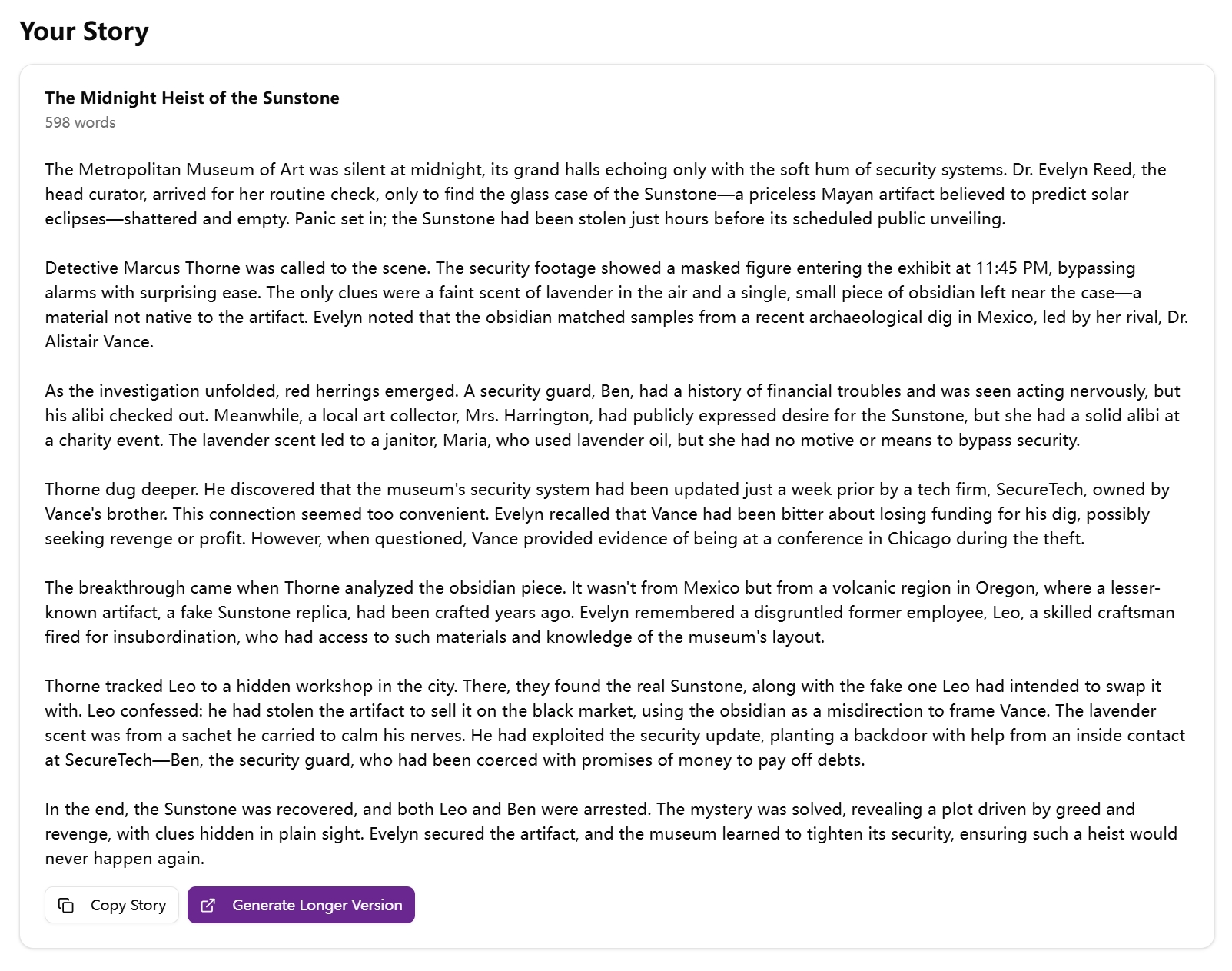
This sample shows the output style and structure this tool can generate.
Move this result into the next focused tool instead of starting over.
How the Mystery Story Generator Works
Turn an idea into a fair-play whodunit with clues and a reveal in three steps.
Describe your idea
Enter a mystery idea — a locked room, a missing person — or leave it blank for a random case.
Add keywords
Add terms like detective, clues, suspects, or red herring to steer the case.
Generate your story
Get a whodunit with a suspect pool, fair clues, and a reveal that follows from what's shown.
Why Choose This Generator
Fair-Play Clues
Every essential clue appears on the page before the reveal, so a careful reader can genuinely solve the case.
Red Herrings Done Right
False leads that still make sense after the truth comes out, teaching the detective something on the way down.
Cozy or Noir
Steer toward a warm small-town cozy or a hard-boiled noir, and the tone, stakes, and clue types adjust to match.
Expand to Full Story
Like the whodunit? Expand it into a longer, multi-chapter story with the full generator in one click.
Who It Is For
Whodunit Authors
Build a locked-room or small-town mystery with a suspect pool whose motives keep every interview tense.
Cozy and Noir Writers
Try the same premise in both registers — warm and witty versus dark and ambiguous — to find the right voice.
Puzzle and Game Designers
Sketch a fair-play case with a closed circle of suspects that you can adapt into a scenario or an escape room.
The Anatomy of a Mystery Plot
Every mystery runs on the same skeleton: a crime or question, an investigator, a set of suspects, and a trail that narrows toward the truth. State the puzzle early and keep the rules fair, so the solution never relies on a fact never shown. A mystery story generator builds that skeleton so the logic holds.
- State the puzzle early and keep the rules fair
- Let each clue rule someone out while raising the stakes
- Build the skeleton so the solution never relies on hidden facts
Planting Clues Readers Can Actually Find
A fair mystery hides its clues in plain sight. The best clues are specific and physical — a mismatched button, a receipt with the wrong time, a phrase someone shouldn't know — shown once, early, without a spotlight. The careful reader can solve it; the rest get the satisfaction of looking back.
- Make clues specific and physical rather than abstract or vague
- Show each clue once, early, and without a spotlight
- Let the careful reader solve it and the rest enjoy looking back
Red Herrings Done Right
A red herring is a false trail that must still make sense after the truth comes out. The suspect with a guilty secret is a classic — lying, but about something else. Plant each false lead with the same care as a real clue, and let it teach the detective something on the way down.
- Make false trails that still make sense after the reveal
- Give the red-herring suspect a secret unrelated to the crime
- Let each false lead teach the detective something
Choosing Your Detective and Their World
The detective is the reader's stand-in, so their strengths and blind spots shape the investigation. Their world matters too — a village where everyone's related plays differently from a locked-room manor. Decide what your detective can't see, and let that blind spot drive the middle.
- Give the detective strengths and a blind spot that drives the middle
- Let the setting limit who could have done it
- Tighten the suspect pool through the closed circle of the world
Pacing the Big Reveal
The reveal should land like the answer you almost had, not the answer you were handed. Save it for after the false confessions and last-minute alibis, restate the key clues briefly, then deliver the solution plainly — and let the culprit's motive answer why as well as who.
- Save the reveal for after false confessions and last-minute alibis
- Restate the key clues so the reader snaps them into place
- Let the culprit's motive answer why, not just who
Fair-Play Clues
Fair-play means the reader has the same information as the detective. Every essential clue appears on the page before the reveal, even if it's disguised. The satisfaction comes from realizing the answer was always visible. A good test: could a careful reader genuinely solve it? If not, add one more clue and pull one more misdirection.
The Closed Circle
A closed circle — a stranded train, an island, a snowed-in manor — limits the suspect pool and raises the pressure. Everyone's trapped, so the culprit is among them, and that proximity breeds suspicion. It's an efficient engine for a whodunit because the setting does half the narrowing for you.
Suspect and Motive
Every suspect needs a motive the reader can understand and a secret worth protecting. Motive is what separates a mystery from a list of alibis. Give the innocent characters guilty reasons too — debts, affairs, grudges — so the detective can't clear anyone too easily. Rich motives make every interview tense.
Cozy vs Noir
Cozy mysteries favor amateur sleuths, small towns, and violence kept off the page; noir favors hard-boiled detectives, moral gray zones, and a world where justice is partial. The choice shapes everything from tone to clue types. Cozies reward warmth and wit; noir rewards cynicism and consequence.
See What a Mystery Story Generator Creates
Real whodunits with fair clues and earned reveals — here's what a typical run returns.
Frequently Asked Questions
Explore More Story Tools
Ready to Crack Your Mystery Story?
Plant fair clues, red herrings, and a reveal that feels earned — with 20 free credits on signup.












































 Featured on AI Ranking










 Just Hunt