Storyline Generator
Trace the one thread that runs through the story, plus how key characters change.
Provide a basic story idea to guide the storyline generation
Choose a genre to tailor the storyline structure
Please sign in to use this tool
First-time visitors can generate 1 result for free, no sign-in required. Credits are only needed after the free trial.
This sample shows the output style and structure this tool can generate.
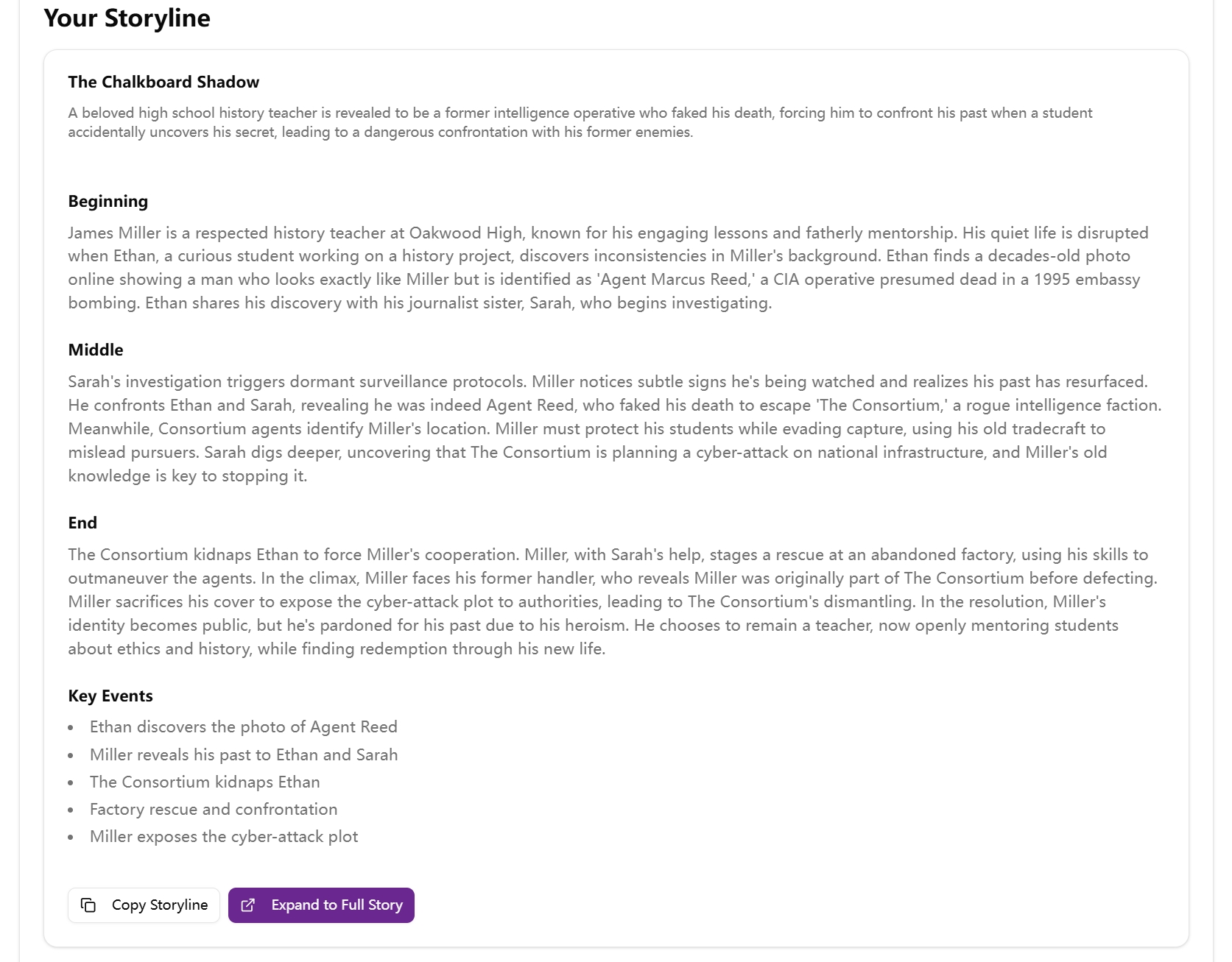
Move this result into the next focused tool instead of starting over.
How the Storyline Generator Works
Enter a concept, pick an optional genre, and get a coherent arc with a beginning, middle, and end.
Describe your concept
Enter a story idea or leave it blank to let the generator start from scratch.
Pick an optional genre
Choose a genre to shape the structure, or skip it for a flexible arc.
Generate your arc
Click Generate Storyline and get a beginning, middle, and end in seconds for one credit.
Why Choose This Generator
Storyline generator for any arc
Turn a rough concept into a coherent thread with a clear beginning, middle, and end in one run.
Series and saga ready
Sketch a spine you can extend across books, seasons, or campaign chapters without losing the through-line.
Character-line weaving
Surface the collisions between character goals so scenes generate themselves from conflict.
Copy and expand
Save your arc, then expand the one you like into a full story with the main generator.
Who It Is For
Novelists and screenwriters
Map the emotional through-line before arranging scenes, so a busy plot still matters — the storyline generator keeps every chapter tied to the character journey.
Game masters
Plan turning points and character goals that survive player choices and bend around whatever the table does.
Series authors
Keep individual books satisfying while a larger thread stays intact across the whole set.
Storyline vs Plot: Clearing Up the Confusion
People use the two words interchangeably, but they describe different layers. A plot is the sequence of events: what happens, in what order. A storyline is the thread those events hang from — the character's journey and the question that keeps readers invested. Think of the plot as the route and the storyline as the reason for the trip. This storyline generator plans the thread first — the emotional route — then suggests plot events that serve it.
- Treat the plot as events and the storyline as the emotional thread
- Name the central question that keeps readers invested
- Check that a busy plot still serves a clear journey
Crafting Storylines for Series and Sagas
A series lives or dies on the long game. Each book needs its own satisfying arc, but the storylines have to interlock across volumes, with questions answered and new ones opened. Decide what changes permanently in every installment and what stays open for later — the storyline generator surfaces that series spine before you draft a single book, then let each book carry a smaller version of the same shape.
- Map the big turning points before drafting any single book
- Resolve one question per volume while opening the next
- Give every installment its own arc that mirrors the series spine
Storylines for Games, RPGs, and Campaigns
Game masters and solo players use storylines a little differently. Here the arc has to survive players making their own choices, so you plan turning points and character goals rather than a fixed sequence. Give each session a hook, a complication, and a decision that matters, then braid them into a larger thread over time.
- Plan turning points instead of a fixed scene sequence
- Build each session around a hook, a complication, and a choice
- Keep the villain's plan moving even when players wander
Weaving Character Lines into One Storyline
Every major character carries their own thread — a want, a wound, and a change they're heading toward. The main storyline is what happens when those threads tangle. The mechanic hiding a lie, the detective chasing a grudge, and the witness who wants to go home each need a small arc that pays off.
- List what each character wants and where goals collide
- Give every major thread a want, a wound, and a change
- Let collisions between character goals generate scenes naturally
Learning from Storylines You Already Love
Pick a story you've finished more than once and reverse-engineer it. Write down the question it opens with, the midpoint where everything changed, and the payoff at the end. You'll usually find the same three or four beats beneath wildly different genres. The goal isn't to imitate; it's to understand why a shape feels satisfying.
- Reverse-engineer favorites to find their shared story beats
- Note the opening question, the midpoint, and the final payoff
- Borrow the shape, not the plot, to understand why it works
The character spine
Start every storyline with a character who wants something and can't get it easily. The want drives the arc; the obstacle keeps it interesting. When you know those two things, the beginning, middle, and end start to write themselves, because each beat is just a step closer to or farther from the goal.
Rising tension in beats
A storyline needs pressure that builds, not a flat list of events. Give each new turn a higher cost than the last: a small favor becomes a lie, a lie becomes a betrayal. When every beat raises the stakes, readers feel momentum even in the quiet scenes.
The midpoint shift
Halfway through, something should change the game. The character learns the truth, loses an ally, or chooses a side. This shift stops the middle from sagging and turns everything before it into setup for what comes next. If your middle feels slow, the missing piece is usually right here.
Genre expectations
A romance storyline promises a relationship at stake; a thriller promises a clock. Name the promise your genre makes and make sure your arc keeps it. Readers forgive surprises, but they rarely forgive a storyline that breaks the promise that got them to open the book in the first place.
Testing the ending
Before you commit, check that the ending answers the question the opening asked. If the first page promises a search for truth, the last page should deliver one. A storyline that opens with one question and closes with another leaves readers satisfied but slightly cheated, so match the two deliberately.
See What It Creates
A single narrative arc with a beginning, middle, and end you can refine or expand.
Frequently Asked Questions
Explore More Story Tools
Ready to Map Your Storyline?
Turn a rough idea into a full storyline arc and start writing with 20 free credits on signup.












































 Featured on AI Ranking










 Just Hunt