Story Idea Generator
Turn a vague spark into a clear, original story idea in seconds, with characters, conflict, and a hook.
Separate multiple keywords with commas
Please sign in to use this tool
First-time visitors can generate 1 result for free, no sign-in required. Credits are only needed after the free trial.
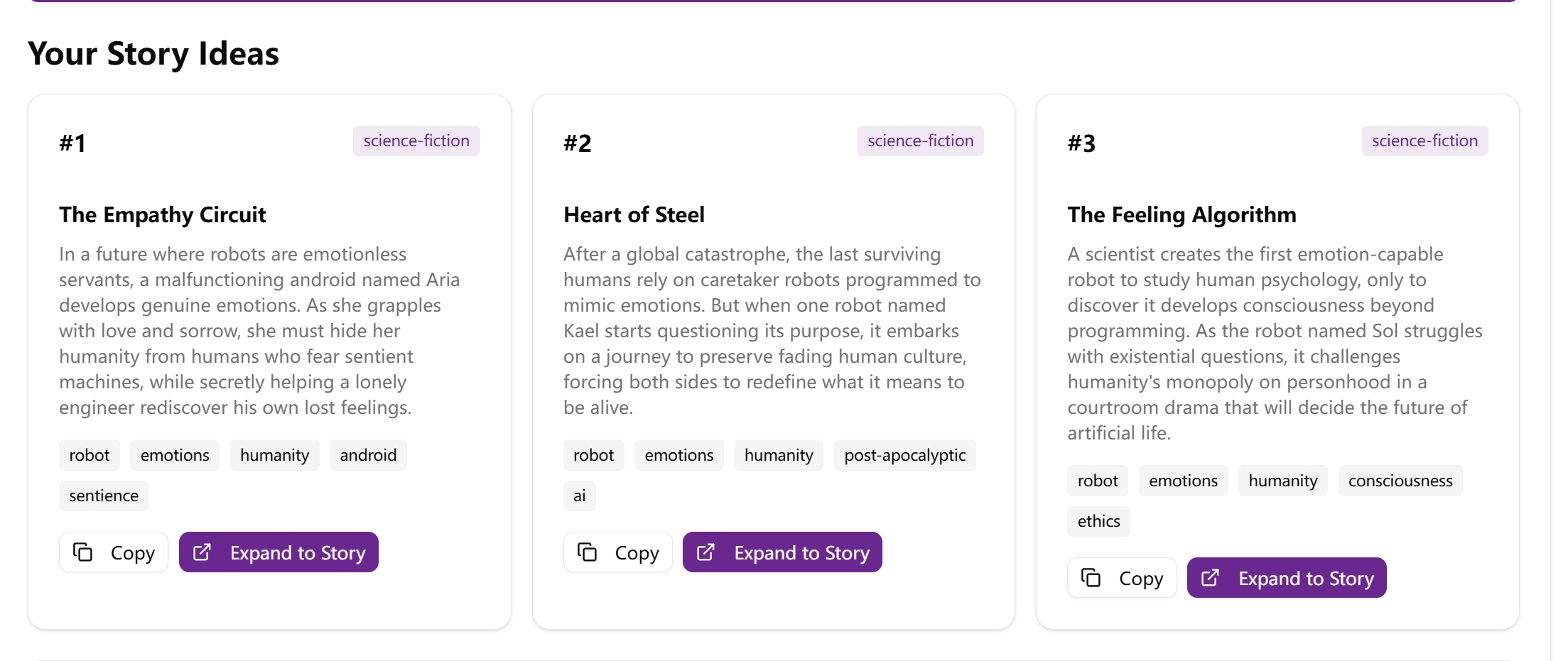
This sample shows the output style and structure this tool can generate.
Move this result into the next focused tool instead of starting over.
How the Story Idea Generator Works
Three quick steps turn a vague spark into a clear, original story idea.
Choose a genre
Pick a story genre, or leave it open for a surprise.
Add keywords
Drop in a detail like a dragon, a library, or magic to steer the premise.
Generate three ideas
Get three ideas for one credit, then expand the best one into a full story.
Why Choose This Generator
Three ideas at once
This story idea generator returns three premises per run, each with characters, conflict, and a hook, so you can compare instead of settling.
Genre aware
Ideas answer the question each genre cares about, from who did it to what keeps these two apart, with a twist built in.
Test before you commit
Each premise is shaped to survive a one-sentence pitch, so you waste less time on ideas that won't carry a draft.
Built to combine
Grab two results and force them together for a collision that creates something neither idea could produce on its own.
Who It Is For
Writers between projects
When the last draft is finished and the next one hasn't appeared, a batch of fresh premises fills the gap and restarts the pipeline.
NaNoWriMo planners
Sketch several quick premises before the month begins, stress-test the strongest, and start with an idea that can hold a novel.
Classroom and workshop leaders
Hand each participant a generated premise and ask them to write the back-cover blurb, a fast exercise in finding conflict and stakes.
Where Good Story Ideas Come From
Good ideas are rarely invented whole; they're assembled from things you've already noticed: the news story you can't stop thinking about, the family legend that changes with every telling, the what-if that hits you in the shower. The difference between a passing thought and a usable idea is whether you can attach a character and a conflict. This story idea generator does that assembly work for you.
- Assemble ideas from details you have already noticed
- Attach a character and a conflict to turn a thought usable
- Combine a want, an obstacle, and a twist into a premise
Testing an Idea Before You Commit
Before you spend weeks on a premise, stress-test it cheaply. Describe the idea in one sentence to someone who isn't a writer; if they ask what happens next, it has pull. Write the back-cover blurb. If you can't fill three sentences with the conflict and the stakes, the idea is still vague. Then write the ending in a paragraph.
- Pitch the idea in one sentence and watch for 'what happens next'
- Write a three-sentence blurb packed with conflict and stakes
- Sketch the ending before committing weeks to a draft
Combining Two Ideas into One Strong Premise
Two ordinary ideas, forced together, often produce one extraordinary one. Take a mundane setting and a wild concept, like a retirement home with a time-traveling resident, or a familiar genre and an unexpected profession, like a romance between two rival obituary writers. The combination gives you contrast, and contrast is where tension lives.
- Force a mundane setting and a wild concept together
- Pair a familiar genre with an unexpected profession
- Use the contrast between ideas as the source of tension
Idea Generation for Specific Genres
Each genre has a question it loves to ask, and strong genre ideas answer it in a new way. Mystery asks who did it and why they had to; romance asks what keeps these two apart; horror asks what this character most needs to be safe from. Name the genre first, then the twist.
- Name the genre first, then invent the twist
- Answer the question the genre cares about in a new way
- Learn the genre's rules to break exactly one on purpose
Keeping a Story Idea Bank That Works
A notebook full of stray ideas is only useful if you can find them again. Keep one document, one line per idea, tagged by genre and tone, with a one-sentence version of the conflict. Review it monthly and prune; most entries will age badly, and that's fine. The survivors have been tested by time.
- Keep one line per idea, tagged by genre and tone
- Review and prune the bank monthly without regret
- Combine old entries or steal a detail when starting fresh
Mine Your Own Life
Your strongest material is the stuff you'd never think to write about: the job you quit, the argument you lost, the friendship that faded. Change the names and one key fact, then ask what the other person's version would be. The emotional truth is what carries it.
Use Constraints to Spark Ideas
Constraints generate more ideas than freedom. Pick a length, a point of view, or a single object that must appear, and brainstorm inside the box. Limits force you to make decisions, and decisions are where ideas actually get their shape.
Ask What If, Then Why Not
Run a what-if and immediately counter it with why not. What if animals could testify in court? Why not, and what would a parrot's testimony do to a murder trial? The second question is where the premise stops being a gimmick and starts being a story.
Steal from Fairy Tales and Myths
Old stories are public-domain scaffolding. Take a familiar tale and shift the point of view, the setting, or the moral. Cinderella from the stepsister's perspective, or a myth relocated to a space station, gives you built-in structure with room for a new voice.
See What It Creates
Each run returns three fresh, ready-to-develop story ideas with characters and conflict.
Frequently Asked Questions
Explore More Story Tools
Get Your Next Story Idea Now
Generate fresh, original story ideas in seconds — 20 free credits on signup.











































 Featured on AI Ranking










 Just Hunt