Short Story Generator
Turn one small idea into a tight, complete story with a beginning that hooks and an ending that lands.
Please sign in to use this tool
First-time visitors can generate 1 result for free, no sign-in required. Credits are only needed after the free trial.
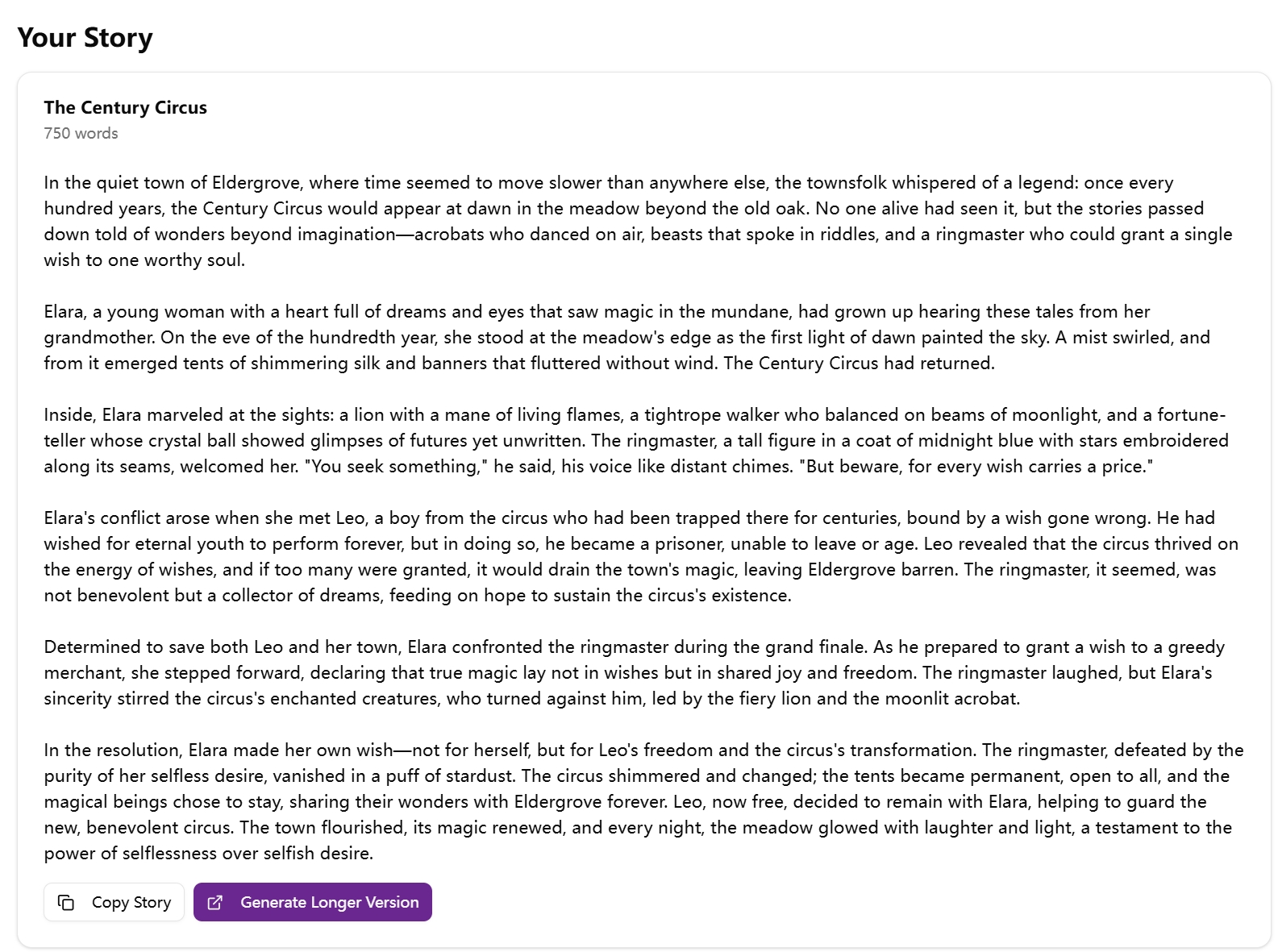
This sample shows the output style and structure this tool can generate.
Move this result into the next focused tool instead of starting over.
How the Short Story Generator Works
Turn one small idea into a complete story in three steps.
Add Your Idea
Type a premise like 'a mysterious letter arrives', or let the tool surprise you.
Pick Genre and Length
Choose a genre and a word range, from flash fiction to a medium story.
Generate and Refine
Get a complete tale with a beginning, a turn, and an ending you can edit.
Why Choose This Generator
Complete Arcs, Not Fragments
Every output has a setup, a complication, and a turn, so you receive a finished story instead of a prompt that trails off.
Length You Control
Pick flash fiction, a short story, or a medium length, and the structure adapts to the room your word count allows.
Genre-Aware Voice
Choose horror, romance, fantasy, science fiction, mystery, or literary fiction, and the tone and pacing shift to match.
One Credit Per Story
Each generation costs a single credit, and welcome credits let you draft several pieces before deciding on a keeper.
Who It Is For
Contest Writers
Writers targeting a specific word cap use this short story generator to draft something that already fits the length, then tighten the ending before submitting.
Daily Practitioners
Anyone building a writing habit uses one idea a day to produce a complete piece in minutes, keeping momentum without a long project.
Prompt-to-Plot Writers
A writer with a loose image or line turns it into a finished story, using the output as a skeleton to rewrite in their own voice.
The Quiet Art of the Short Story
A short story isn't a novel with fewer words; it's a different kind of promise. It offers one idea, one turn, one moment of recognition—and then it's gone. Because space is tight, every sentence has to reveal character, advance the plot, and set a mood all at once. A good short story generator respects that economy, returning complete arcs instead of fragments. The short story generator drafts to the length you set, so the idea, the turn, and the recognition all fit the space you have.
- Make every sentence reveal character, plot, and mood at once
- Offer one idea, one turn, and one moment of recognition
- Return complete arcs rather than fragments that trail off
How Many Words Counts as 'Short'
The labels shift by market, but the ranges are stable enough to aim at. Flash fiction usually tops out around 1,000 words. A standard short story sits between roughly 1,000 and 7,500, with many contests capping entries at 2,000 or 3,000. Anything longer crosses toward novelette territory. Know your target before you write, because length shapes structure.
- Keep flash fiction under about 1,000 words
- Aim for 1,000–7,500 words for a standard story
- Check contest caps, which often sit at 2,000–3,000
- Let word count shape structure before you draft
Short Story Structures That Satisfy
Most short stories still follow a spine, just compressed: a character with a want runs into an obstacle, and something changes by the end. You don't need five acts—a setup, a complication, and a turn is often enough. Some of the best short fiction uses a single-beat structure: one decision, made under pressure, that redefines everything. Pick the shape that fits the idea.
- Run a want, an obstacle, and a change through the spine
- Use a setup, a complication, and a turn—not five acts
- Try a single decision made under pressure
- Match the structure to the idea, not the other way
Openings That Land in Fewer Than Ten Words
Readers decide fast, and a short story gives you no prologue to warm up. Open with motion or a specific image, not weather or a character waking up. 'She'd stolen the wrong suitcase.' Each opening raises a question the reader must answer. Write ten openings and keep the one that makes you want to know what happens next.
- Open with motion or a specific image, never a slow warm-up
- Raise a question the reader has to answer
- Skip weather, waking up, and prologue throat-clearing
- Draft ten openings and keep the one that hooks you
Stretching a Short Story into a Novella
If a short story keeps growing in your mind, it may want to be something longer. Find the parts the compressed version skipped: the before, the aftermath, the secondary characters who only got a line. Add a second plot thread and raise the stakes in stages. Keep the original story's core turn as your midpoint or climax. The jump is about deepening what's there, not padding it.
- Recover the before, the aftermath, and side characters
- Add a second plot thread and raise stakes in stages
- Keep the original turn as your midpoint or climax
- Deepen what's already there instead of padding it
One Story, One Idea
A short story has room for one central idea, so pick it and protect it. If a second premise sneaks in—a subplot, a tangent—cut it or fold it into the main thread. Saying one thing well is what separates a tight story from a crammed one. When in doubt, ask what the story is really about and trim everything else.
Cut the First Page
Many drafts start before the story does. Try deleting your first paragraph or two and see if the piece still makes sense—often the real opening is hiding on page two. The setup you think readers need is usually background they can absorb from context. Cut it, and the story starts inside the action where it should.
End Where It Changes
A short story ends at the moment something irreversible happens or is understood—not after the consequences are all explained. Resist the epilogue impulse. Once the character sees the truth or makes the choice, stop. The reader needs the instant the ground shifted, then silence.
Every Character Earns a Line
In a short story, no one gets a free scene. If a character appears, they should do something the plot needs—reveal a secret, apply a pressure, represent a choice. Name only the people who matter; let the clerk and the driver stay anonymous. Each character who earns a line should change the protagonist's options, even slightly.
Read It in One Sitting
A short story is meant to be experienced whole, so draft with that in mind. Read your piece straight through and mark where your attention wandered—those are the cuts. If the pace drags, it shows more than in a novel. The form's power is compression; let it land all at once.
See What the Short Story Generator Creates
Tight, complete stories with a hooking opening and an ending that lands.
Frequently Asked Questions
Explore More Story Tools
Story Idea Generator
Find the single spark worth turning into a complete short piece.
Try Story Idea GeneratorStory Plot Generator
Map the beats of a story before you commit to the draft.
Try Story Plot GeneratorReady to Write Your Short Story?
Turn one small idea into a tight, complete short story—start with 20 free credits on signup.












































 Featured on AI Ranking










 Just Hunt