
Story Topic Generator
Pick a genre, add a theme, and turn a blank page into a story worth writing.
Separate multiple keywords with commas
Please sign in to use this tool
First-time visitors can generate 1 result for free, no sign-in required. Credits are only needed after the free trial.
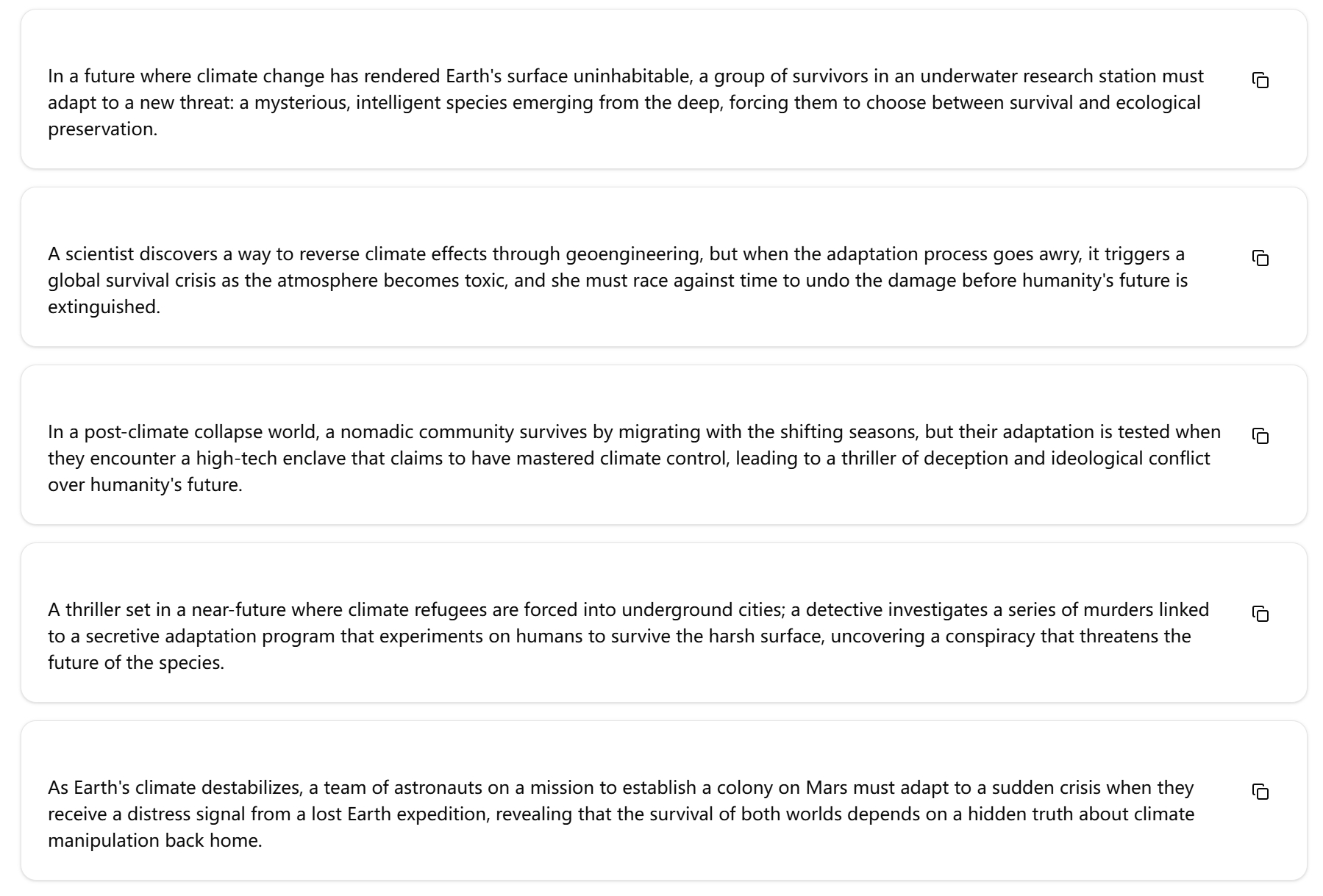
This sample shows the output style and structure this tool can generate.
Move this result into the next focused tool instead of starting over.
How the Story Topic Generator Works
Pick a genre, add a theme, and turn a blank page into five ready-to-write topics in one run.
Choose a genre
Select a genre from the dropdown, then add an optional theme like redemption or discovery.
Add theme and keywords
Refine the direction with a theme and a few comma-separated keywords that match your intent.
Generate five topics
Click Generate 5 Topics and get ready-to-write ideas for one credit.
Why Choose This Generator
Story topic generator in seconds
Pair a genre with a theme and the tool returns five specific topics you can start drafting right away.
Conflict-ready ideas
Every topic carries a built-in friction point, so you skip flat subjects and land on something with real stakes.
Genre and theme filtering
Narrow results by genre and optional theme to match the tone you are already writing in.
Copy, save, and expand
Copy any topic or expand it into a full story in one click when a result feels right.
Who It Is For
Writers between projects
Break the blank page when one manuscript ends and the next has not taken shape yet by generating several directions at once.
Students and classrooms
Give a writing class a quick starting point for prompts, exercises, and short assignments that need a concrete subject.
Content and game creators
Sketch episode ideas, quest hooks, or post concepts by pairing a genre with a theme and generating options.
Choosing Topics Readers Care About
A topic only earns attention when it makes someone feel something. Readers keep turning pages because a topic touches a fear, a hope, or a question they already carry, not because it sounds clever. Before you commit, ask what a reader takes from the journey. The story topic generator pairs a genre with a theme so the result is specific instead of generic.
- Pick topics that touch an existing emotion, not clever-sounding subjects
- Name what the reader takes away from the story before writing
- Pair a genre with a theme to land on a specific premise
Topics with Staying Power Beyond Trends
Trendy topics burn bright and fade fast; the ones worth writing carry a question at their center that outlives the news cycle. Love, loyalty, fear of failure, and the cost of a secret never really go out of style. Before committing, check whether a topic survives a change of setting or decade.
- Choose conflicts that stay relevant across settings and decades
- Test every idea against love, loyalty, or the cost of a secret
- Skip fads that only work on one platform this month
Moving from Topic to Theme
A topic is what the story is about; a theme is what it says about that topic. A robbery is a topic; what a person will do for family is a theme, and that gives the robbery its weight. Writers stall when they stay at the topic level, and scenes feel flat. Name the deeper question your topic is really asking.
- Treat the topic as the subject and the theme as its message
- Decide what belief about that subject your ending should defend
- Push past the topic level so scenes stop feeling random
Finding Your Niche as a Writer
A niche isn't a cage; it's where what you love meets what readers keep asking for. The writers who build real audiences usually stay in one lane long enough to be recognized: cozy mystery, middle-grade adventure, slow-burn romance. That doesn't mean writing the same story forever, just returning to the same emotional territory.
- Define your lane as an overlap of love and reader demand
- Return to the same emotional territory across projects
- Run the tool across several genres to spot what excites you
Testing a Topic Before You Write It
Before you invest a weekend in a topic, stress-test it in five minutes. Can you picture the main character making a difficult choice? Does the conflict tighten with every scene, or does it lean on one lucky coincidence? Would you still write this if nobody ever read it? Generate several candidates, then keep the one that passes.
- Require a protagonist facing a hard, clear choice
- Confirm the conflict tightens scene by scene without lucky coincidences
- Keep only the candidate you would write even unread
Mining the everyday
The strongest topics often sit in ordinary life: a neighbor's habit, a delayed train, an awkward dinner. Notice the moments that made you feel something today and ask what would have changed if one detail were different. A small, true observation usually beats a grand premise you have no grip on.
Genre as a filter
Genre isn't decoration; it's a promise about what the reader will feel. A horror topic promises dread, a romance promises longing, and a mystery promises the thrill of solving. Choose a genre first and the topic narrows itself, because every genre has conflicts it handles better than others. Let it do half the brainstorming.
The one-sentence test
If you can't compress a topic into one clear sentence, it may still be too vague. Try the formula: a protagonist with a problem, in a place, against a clock. When the sentence reads clean, you have something to build on. When it doesn't, you know which piece still needs deciding.
Topics with built-in conflict
A topic without friction isn't a story yet. Look for versions that force a choice between two things the character wants, or two duties that can't both be honored. Conflict is what turns a subject into a plot, so favor topics where something is already at stake and someone is in the way.
Keeping a topic journal
Write down every topic that interests you, even the ones you'll never use. A running list becomes raw material later, and half-formed ideas have a way of combining into something better. Review it when you're stuck and you'll often find the seed of your next story was already sitting there.
See What It Creates
Five ready-to-write topics per run, each with enough direction to open a draft.
Frequently Asked Questions
Explore More Story Tools
Ready to Find Your Next Story Topic?
Generate five fresh story topic ideas in seconds and start writing with 20 free credits on signup.












































 Featured on AI Ranking










 Just Hunt