
Story Setting Generator – Create Unique Story Worlds Instantly
Get a vivid, named world with its own rules and atmosphere in seconds.
Leave blank for random story settings.
Comma-separated; helps the story setting generator focus.
Please sign in to use this story setting generator.
First-time visitors can generate 1 result for free, no sign-in required. Credits are only needed after the free trial.
This sample shows the output style and structure this tool can generate.
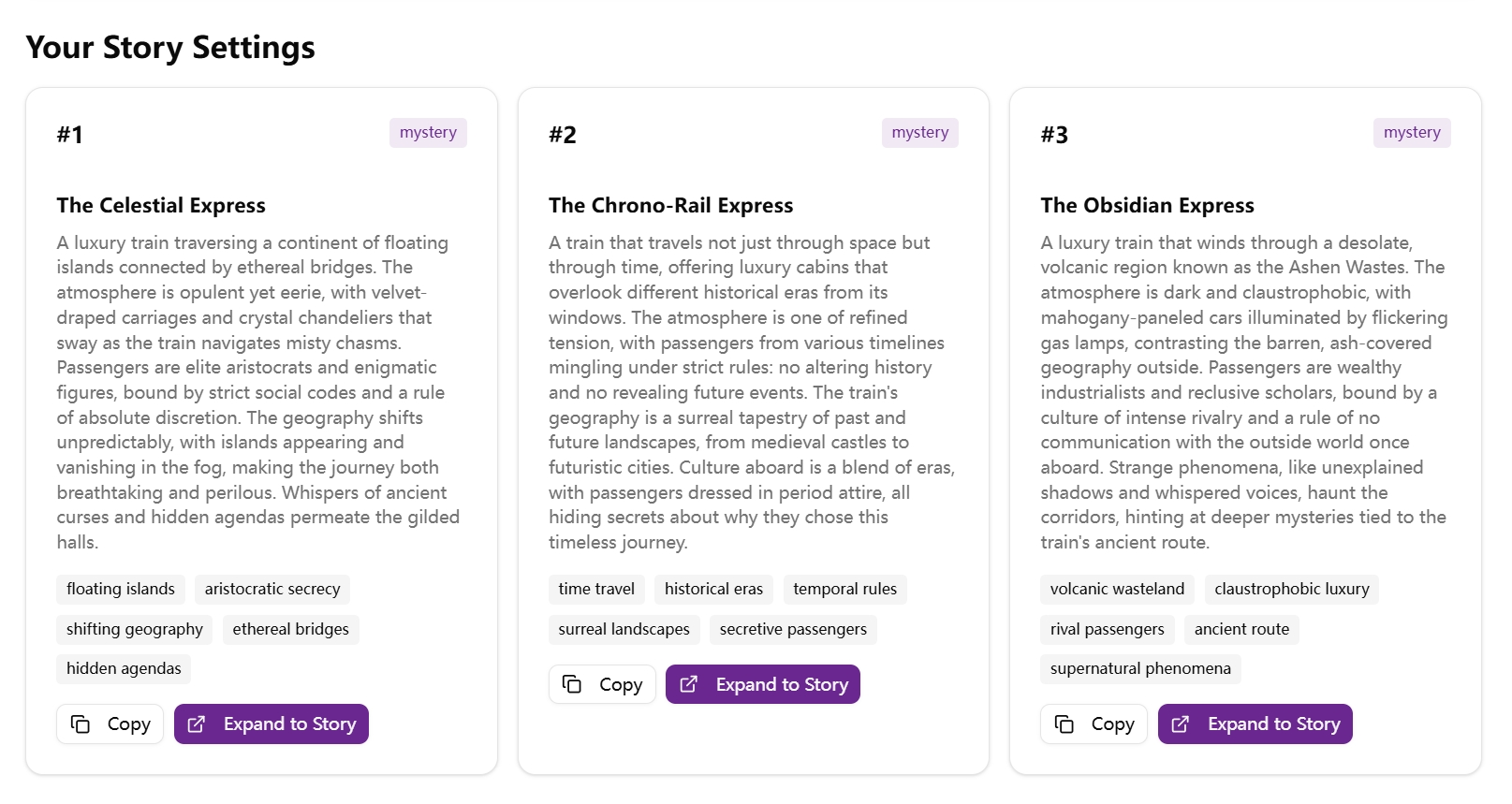
Move this result into the next focused tool instead of starting over.
How the Story Setting Generator Works
Build a vivid, named world with its own rules and atmosphere in three quick steps.
Add a theme or hint
Describe a place or leave it blank to get a random world.
Choose a genre and keywords
Pick a genre and add keywords like magic, trade, or rebellion to steer the details.
Generate your world
Get a named setting with geography, culture, and rules — ready to write in.
Why Choose This Generator
Complete, Named Worlds
Generate a named place with atmosphere, culture, and rules, so you start writing instead of worldbuilding.
Atmosphere on Tap
Land mood-rich detail — a foggy port, a neon skyline, a crumbling mansion — matched to your genre.
Plot-Driving Pressure
Built-in terrain, weather, and local conflict give your characters something to push against.
Any Genre, Any Era
Generate fantasy kingdoms, sci-fi colonies, historical periods, and modern realism with equal ease.
Who It Is For
Fantasy and sci-fi writers
Skip the blank-map stage with a ready world that has rules and limits, then deepen the parts your story needs.
Historical fiction authors
Start from an era and build accurate, textured places without turning your draft into a textbook.
Roleplayers and game masters
Spin up a fresh setting for a campaign or session, complete with the conflicts that keep players moving.
Why Setting Matters More Than You Think
Setting isn't wallpaper — it's the soil the story grows in. A heist in a foggy port feels different from the same heist in a desert town, even if the beats are identical. Place shapes what characters can do, fear, and say, and it carries theme. A story setting generator gives you that soil ready-made.
- Treat place as soil, not wallpaper, for the story
- Change one setting detail to shift the whole mood
- Let place shape what characters do, fear, and say
Worldbuilding That Works in Any Genre
Good worldbuilding is consistent, not necessarily big. Even a contemporary romance needs rules — where people work, what they can afford, what they're hiding. Start with three questions: what does this place have, what does it lack, and what do people disagree about?
- Ask what the place has, lacks, and argues about
- Apply the same rules to fantasy kingdoms and suburbs
- Let those answers generate conflict on their own
Settings That Actively Drive the Plot
The best settings push back. A blizzard traps the characters; a flooded city reroutes them; a small town's gossip changes what they can hide. When the place makes choices for your characters, the story becomes a collision. Pick the pressure that matches the story you want to tell.
- Give the place a pressure: terrain, weather, rules, or conflict
- Let the setting force choices your characters must make
- Match the pressure to the story you want to tell
Describing Places Without Boring Readers
Readers don't want a weather report; they want a feeling plus one sharp detail. 'The kitchen smelled of bleach and burnt toast' does more than a paragraph of inventory. Choose two or three sensory details and filter them through what the character notices and ignores.
- Pick two or three sensory details that imply the rest
- Filter description through the character's mood and focus
- Show the place through what a character notices and ignores
Historical, Modern, and Imagined Settings
Historical settings need accurate texture — the right tools, money, and manners — without turning into a textbook. Modern settings need specific, believable places rather than generic fog. Imagined settings need internal rules the reader can trust. Start any of the three, then deepen the details.
- Give historical worlds accurate tools, money, and manners
- Trade generic fog for a specific, believable modern place
- Set internal rules readers can trust in imagined worlds
Fantasy Worlds
Kingdoms, enchanted forests, floating cities. The magic needs limits — what it costs, who can't use it — or the world feels weightless. Anchor wonder with rules and the story holds.
Sci-Fi Worlds
Space stations, future Earths, alien colonies. The best sci-fi settings show how technology reshaped daily life, from jobs to laws, not just the gadgets.
Historical Periods
Texture matters: trade, food, belief, class. A few accurate details read as authentic, while anachronisms break the spell. Research the small stuff, not just the events.
Modern Realism
Specificity is your weapon: a laundromat, a bus route, a neighborhood's unwritten rules. Real places carry history and class without you having to explain either.
Blended Settings
Mix eras and genres: dieselpunk ports, magical realism in a city you know. The blend works when one element stays familiar and the other surprises.
See What It Creates
A named, atmospheric setting with geography, culture, and rules, ready to build on.
Frequently Asked Questions
Explore More Story Tools
Build a Vivid World with a Story Setting Generator
Create a named, atmospheric world with its own rules in seconds — get 20 free credits on signup.











































 Featured on AI Ranking










 Just Hunt